Question
If the horizontal force needed for the turn in the previous problem is to be supplied by the normal force by the road, what should be the proper angle of banking?

Answer

in the diagram
$\text{R}\cos\theta=\text{mg}\ \dots(1)$
$\text{R}\sin\theta=\frac{\text{mv}^2}{\text{r}}\ \dots(2)$
Dividing equation (1) with equation (2),$\tan\theta=\frac{\text{mv}^2}{\text{rmg}}=\frac{\text{v}^2}{\text{rg}}$
$\text{v}=36\text{km}/\text{hr}=10\text{m}/\text{sec},\text{r}=30\text{m}$
$\tan\theta=\frac{\text{v}^2}{\text{rg}}$
$=\frac{100}{30\times10}=\frac{1}{3}$
$\Rightarrow\theta=\tan^{-1}\Big(\frac{1}{3}\Big)$

Need a full question paper?

Generate a complete, print-ready paper with questions like this in minutes — across 16+ boards, with answer keys.
Start Generating Free

Similar questions

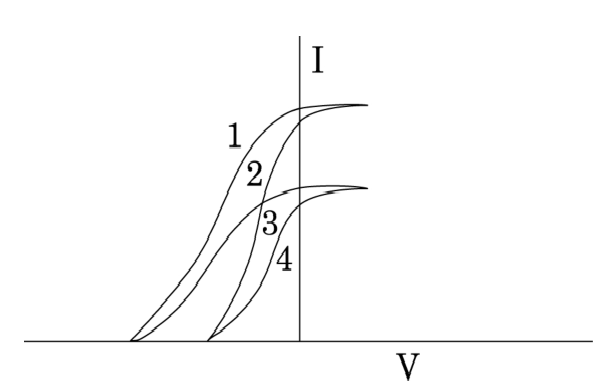
The given graph shows the variation of photo-electric currently) with the applied voltage(V) for two different materials and for two different intensities of the incident radiations. Identify and explain using Einstein's photo electric equation the pair of curves that correspond to (i) different materials but same intensity of incident radiation (ii) different intensities but same materials.
radioactive isotope has a half-life of 5 years. After how much time is its activity reduced to 3.125% of its original activity?
A hot gas emits radiation of wavelengths 46.0nm, 82.8nm and 103.5nm only. Assume that the atoms have only two excited states and the difference between consecutive energy levels decreases as energy is increased. Taking the energy of the highest energy state to be zero, find the energies of the ground state and the first excited state.
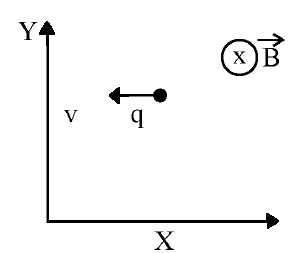
  1. A point charge q moving with speed v enters a uniform magnetic field B that is acting into the plane of the paper as shown. What is the path followed by the charge q and in which plane does it move?
  2. How does the path followed by the charge get affected if its velocity has a component parallel to $\overrightarrow{\text{B}}$?
  3. If an electric field $\overrightarrow{\text{E}}$ is also applied such that the particle continues moving along the original straight line path, what should be the magnitude and direction of the electric field $\overrightarrow{\text{E}}$?
A uniform rod of mass 300g and length 50cm rotates at a uniform angular speed of 2rad/s about an axis perpendicular to the rod through an end. Calculate:
  1. The angular momentum of the rod about the axis of rotation.
  2. The speed of the centre of the rod.
  3. Its kinetic energy.

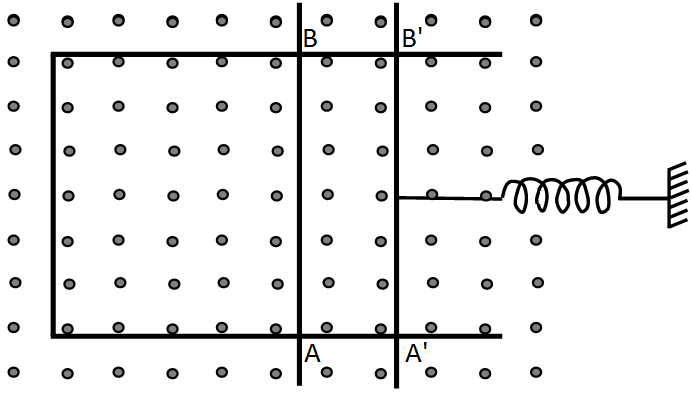
A rectangular wire frame, shown below, is placed in a uniform magnetic field directed upward and normal to the plane of the paper. The part AB is connected to a spring. The spring is stretched and released when the wire AB has come to the position A′ B′ (t = 0) How would the induced emf vary with time? Neglect damping.
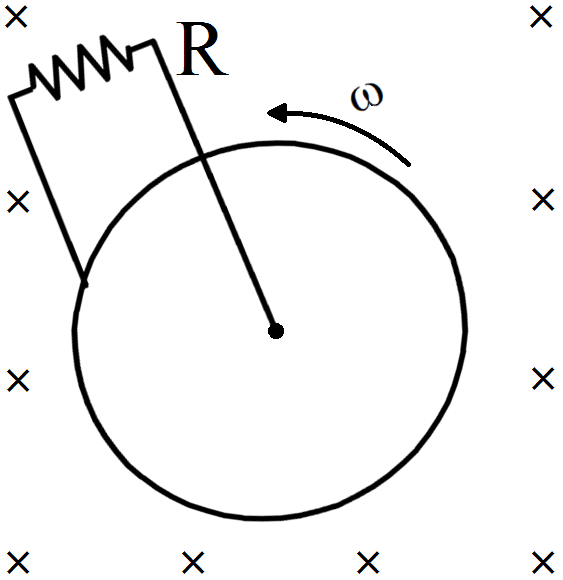
Figure shows a conducting disc rotating about its axis in a perpendicular magnetic field B. A resistor of resistance R is connected between the centre and the rim. Calculate the current in the resistor. Does it enter the disc or leave it at the centre? The radius of the disc is 5.0cm, angular speed $\omega=10 \ \text{rad/s}, \ \text{B}=0.40\text{T}$ and $\text{R}=10\Omega.$
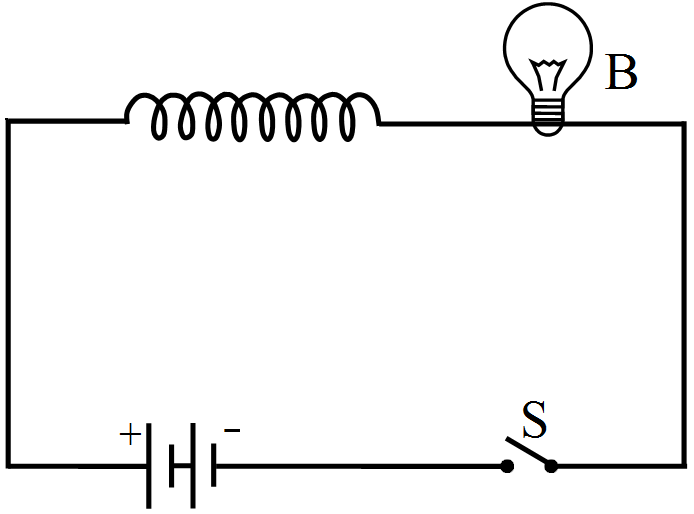
Figure shows a light bulb (B) and iron cored inductor connected to a dc battery through a switch (S).
  1. What will one observe when switch (S) is closed?
  2. How will the glow of the bulb change when the battery is replaced by an ac source of rms voltage equal to the voltage of dc battery? Justify your answer in each case.
One end of a rod of length 20cm is inserted in a furnace at 800K The sides of the rod are covered with an insulating material and the other end emits radiation like a blackbody. The temperature of this end is 750K in the steady state. The temperature of the surrounding air is 300K. Assuming radiation to be the only important mode of energy transfer between the surrounding and the open end of the rod, find the thermal conductivity of the rod. Stefan constant $\sigma=6.0\times10^{-8}\text{Wm}^{-2}\text{K}^{-4}.$
What length of a copper wire of cross-sectional area $0.01mm^2$ will be needed to prepare a resistance of $1\text{k}\Omega?$ Resistivity of copper $=1.7\times10^{-8}\Omega\text{-m}.$