If the length of second's pendulum is decreased by $2\%$, how many seconds it will lose per day ...... $\sec$
Medium
Download our app for free and get started
(d) $T \propto \sqrt l $
==> $\frac{{\Delta T}}{T} = \frac{1}{2}\frac{{\Delta l}}{l} = \frac{{0.02}}{2} = 0.01$
==>$\Delta T = 0.01\,T$
Loss of time per day $ = 0.01 \times 24 \times 60 \times 60$$ = 864\sec $

Download our appand get started for free
Experience the future of education. Simply download our apps or reach out to us for more information. Let's shape the future of learning together!No signup needed.*
Similar Questions
- 1The velocity vector $v$ and displacement vector $x$ of a particle executing SHM are related as $\frac{v d v}{d x}=-\omega^2 x$ with the initial condition $v=v_0$ at $x=0$. The velocity $v$, when displacement is $x$, isView Solution
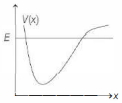
- 2Consider a one-dimensional potential $V(x)$ as shown in the figure below. A classical particle of mass $m$ moves under its influence and has total energy $E$ as shown below. The motion isView Solution
- 3A large horizontal surface moves up and down in $S.H.M.$ with an amplitude of $1\, cm$. If a mass of $10\, kg$ (which is placed on the surface is to remain continuously in contact with it, the maximum frequency of $S.H.M.$ will be .... $Hz$View Solution
- 4A simple harmonic oscillator has a period of $0.01 \,sec$ and an amplitude of $0.2\, m$. The magnitude of the velocity in $m{\sec ^{ - 1}}$ at the centre of oscillation isView Solution
- 5The displacement of a particle is given at time $t$, by:$x=A \sin (-2 \omega t)+B \sin ^2 \omega t \quad$ Then,View Solution
- 6View SolutionFor a particle executing simple harmonic motion, which of the following statements is not correct
- 7Two simple pendulum whose lengths are $1\,m$ and $121\, cm$ are suspended side by side. Their bobs are pulled together and then released. After how many minimum oscillations of the longer pendulum will the two be in phase againView Solution
- 8The time period of a simple pendulum is $2\, sec$. If its length is increased $4$ times, then its period becomes ..... $\sec$View Solution
- 9If a spring extends by $x$ on loading, then energy stored by the spring is (if $T$ is the tension in the spring and $K$ is the spring constant)View Solution
- 10The total energy of particle performing $S.H.M.$ depend onView Solution