MCQ
If the light moving in a straight line bends by a small but fixed angle, it may be a case of:
  1. Reflection.
  2. Refraction.
  3. Diffraction.
  4. Dispersion.
  • A
    Only $A$
  • $A$ and $B$
  • C
    Only $C$
  • D
    $C$ and $D$

Answer

Correct option: B.
$A$ and $B$
When the light strikes on a surface nearly parallel to it, it then bends by a small and fixed angle after reflection. Also, when the light travels from one medium to another with slight differences in their refractive indices, it bends by a small angle. Thus, the bending of light by a small but fixed angle can be the case of either reflection or refraction.

Need a full question paper?

Generate a complete, print-ready paper with questions like this in minutes — across 16+ boards, with answer keys.

Start Generating Free

Similar questions

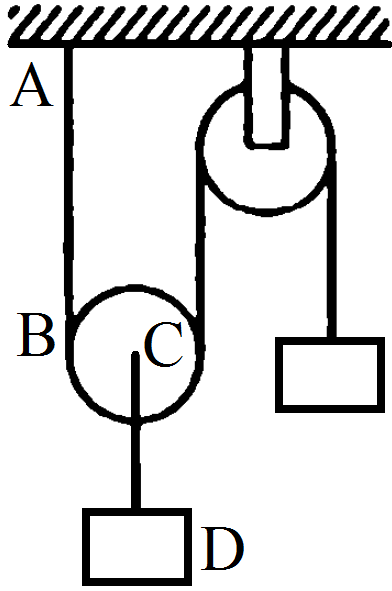
Both the strings, shown in figure are made of same material and have same cross$-$section. The pulleys are light. The wave speed of a transverse wave in the string $AB$ is $\nu_1$ and in $CD$ it is $\nu_2.$ Then $\frac{\nu_1}{\nu_2}$ is:
​​​​​​​
A body $X$ is projected upwards with a velocity of $98\ ms^{-1}$, after $4s,$ a second body $Y$ is also projected upwards with the same $Y$ is also projected upwards with the same initial velocity. Two bodies will meet after:
The rate of radiation of a black body at $0°C$ is $E\,J/sec$ . The rate of radiation of this black body at ${273^o}C$ will be
If one end of a wire is fixed with a rigid support and the other end is stretched by a force of $10 \,N,$ then the increase in length is $0.5\, mm$. The ratio of the energy of the wire and the work done in displacing it through $1.5\, mm$ by the weight is
A wind-powered generator converts wind energy into electrical energy. Assume that the generator converts a fixed fraction of the wind energy intercepted by its blades into electrical energy. For wind speed $v$, the electrical power output will be most likely proportional to
A block of ice of mass $120\,g$ at temperature $0^{\circ} C$ is put in $300\,gm$ of water at $25^{\circ} C$. The $xg$ of ice melts as the temperature of the water reaches $0^{\circ} C$. The value of $x$ is

[Use: Specific heat capacity of water $=4200$

$J\,kg ^{-1} K ^{-1}$, Latent heat of ice $\left.=3.5 \times 10^{5} J\,kg ^{-1}\right]$

The velocity $v$ (in $cm/\sec $) of a particle is given in terms of time $t$ (in sec) by the relation $v = at + \frac{b}{{t + c}}$ ; the dimensions of $a,\,b$ and $c$ are
A large tank is filled with water to a height $H$. A small hole is made at the base of the tank. It takes ${T_1}$ time to decrease the height of water to $\frac{H}{\eta }\,(\eta > 1)$; and it takes ${T_2}$ time to take out the rest of water. If ${T_1} = {T_2}$, then the value of $\eta $ is
Mark the correct statements:
A small ball of mass $m$ is thrown upward with velocity $u$ from the ground. The ball experiences a resistive force $mkv ^{2}$ where $v$ is its speed. The maximum height attained by the ball is