MCQ
If the light moving in a straight line bends by a small but fixed angle, it may be a case of:
- AReflection.
- BRefraction.
- CDiffraction.
- DDispersion.
If the light moving in a straight line bends by a small but fixed angle, it may be a case of:
Explanation:
When the light strikes on a surface nearly parallel to it, it then bends by a small and fixed angle after reflection. Also, when the light travels from one medium to another with slight differences in their refractive indices, it bends by a small angle. Thus, the bending of light by a small but fixed angle can be the case of either reflection or refraction.
Generate a complete, print-ready paper with questions like this in minutes — across 16+ boards, with answer keys.
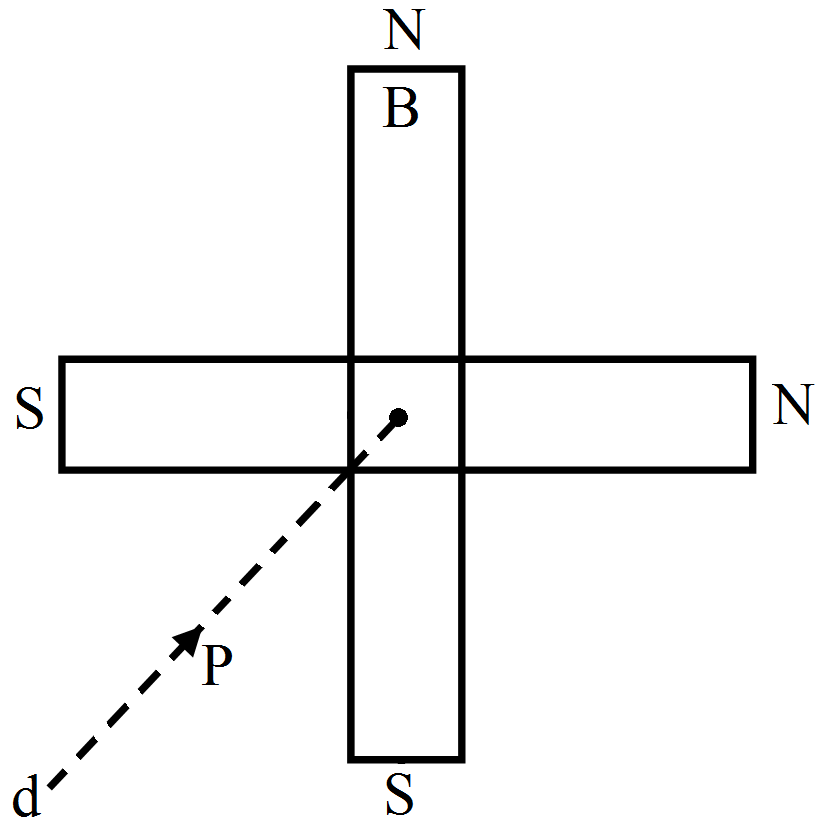
$\frac{\mu_0}{4\pi}\frac{2\text{M}}{\text{d}^3}$
The equivalent resistance between x and y in the circuit shown is

|
(a) 10 W |
(b) 40 W |
(c) 20 W |
(d) |
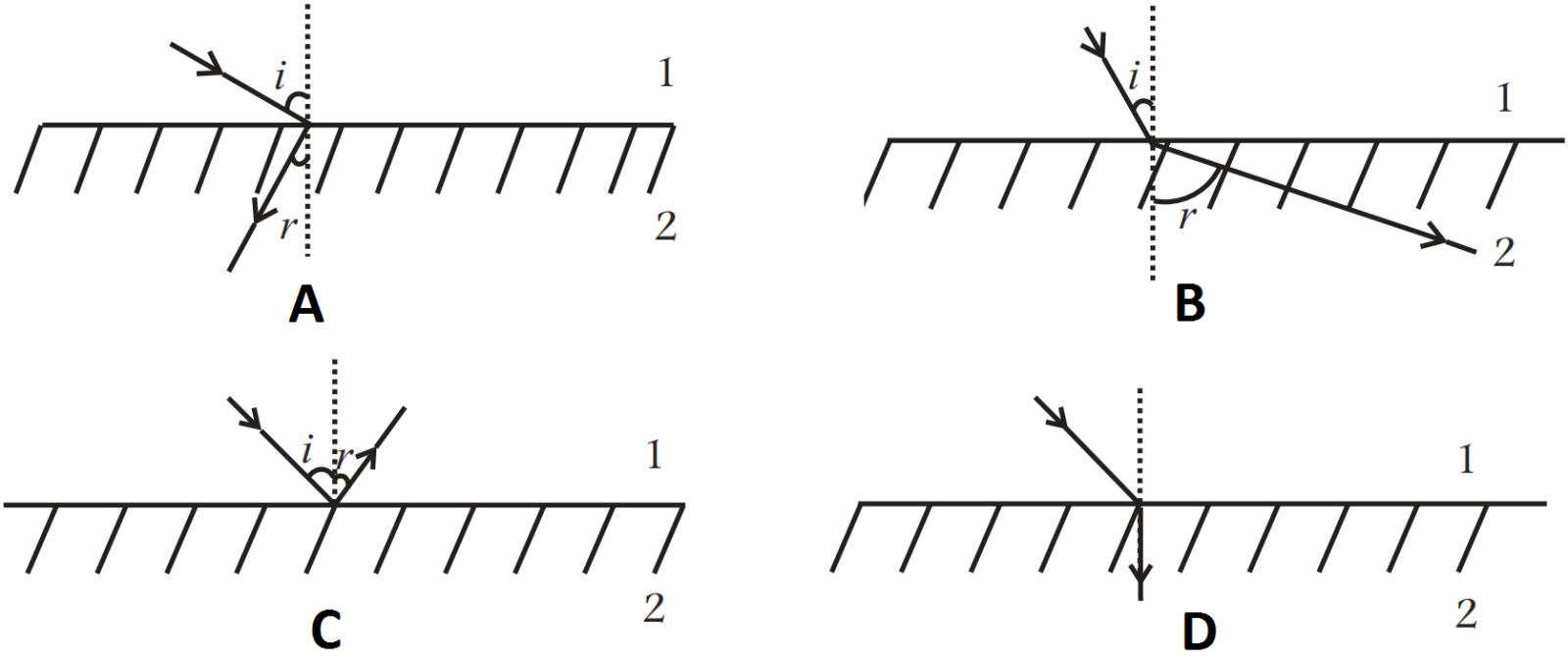
There are certain material developed in laboratories which have a negative refractive index (Fig). A ray incident from air (medium 1) into such a medium (medium 2) shall follow a path given by:
According to classical theory, the circular path of an electron in Rutherford atom is
|
(a) Spiral |
(b) Circular |
(c) Parabolic |
(d) Straight line |
If a convex lens of focal length 80 cm and a concave lens of focal length 50 cm are combined together, what will be their resulting power
|
(a) + 6.5D |
(b) – 6.5 D |
(c) + 7.5 D |
(d) – 0.75 D |
A fish rising vertically up towards the surface of water with speed 3 ms–1 observes a bird diving vertically down towards it with speed 9 ms–1. The actual velocity of bird is

|
(a) 4.5 ms–1 |
(b) 5. ms–1 |
(c) 3.0 ms–1 |
(d) 3.4 ms–1 |
A radio receiver antenna that is 2 m long is oriented along the direction of the electromagnetic wave and receives a signal of intensity 5
 . The maximum instantaneous potential difference across the two ends of the antenna is
| (a) 1.23 mV | (b) 1.23 mV | (c) 1.23 V | (d) 12.3 mV |
