MCQ
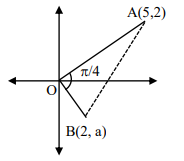
If the line segment joining the points $(5, 2)$ and $(2, a)$ subtends an angle $\frac{\pi}{4}$ at the origin, then the absolute value of the product of all possible values of $a$ is :
  • A
    6
  • B
    8
  • C
    2
  • D
    4

Answer

Image
$ m _{ OA }=\frac{2}{5}$
$m_{ OB }=\frac{ a }{2}$
$\tan \frac{\pi}{4}=\left|\frac{2}{5}-\frac{a}{2}\right|$
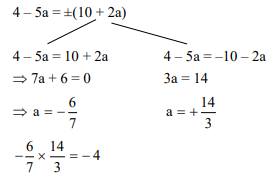
$1=\left|\frac{4-5 a}{10+2 a}\right|$
Image

Need a full question paper?

Generate a complete, print-ready paper with questions like this in minutes — across 16+ boards, with answer keys.

Start Generating Free

Similar questions

If $\int\limits_0^a {\frac{{dx}}{{\sqrt {x + a} \, + \,\sqrt x }}\,\,\,\, = \,\,\,\,} \int\limits_0^{\frac{\pi }{8}} {\frac{{2\,\tan \theta }}{{\sin 2\theta }}\,d\theta } \,$, then the value of $‘a’$ is equal to $(a > 0)$
If $\frac{{3 + 5 + 7 + ..........{\rm{to}}\;n\;{\rm{terms}}}}{{5 + 8 + 11 + .........{\rm{to}}\;10\;{\rm{terms}}}} = 7$, then the value of $n$ is
If $\int {\sqrt 2 \sqrt {1 + \sin x} } \,\,dx = - \,4\cos (ax + b) + c$ then the value of $(a, b) $ is
The equation of line passing through the points of intersection of the circles $3{x^2} + 3{y^2} - 2x + 12y - 9 = 0$ and ${x^2} + {y^2} + 6x + 2y - 15 = 0$, is
The integral $80 \int_{0}^{\frac{\pi}{4}}\left(\frac{\sin \theta+\cos \theta}{9+16 \sin 2 \theta}\right) d \theta$ is equal to :
A player $X$ has a biased coin whose probability of showing heads is $p$ and a player $Y$ has a fair coin . They start playing a game with their own coins and play alternately . The player who throws a head first is a winner. If $X$ starts the game, and the probability of winning the game by both the players is equal, then the value of $'p'$ is
If $f$ and $g$ are differentiable functions in $[0, 1]$ satisfying $f\left( 0 \right) = 2 = g\left( 1 \right)\;,\;\;g\left( 0 \right) = 0,$ and $f\left( 1 \right) = 6,$ then for some $c \in \left] {0,1} \right[$  . .
If $f(x) = \log \left[ {\frac{{1 + x}}{{1 - x}}} \right]$, then $f\left[ {\frac{{2x}}{{1 + {x^2}}}} \right]$ is equal to
The number of $4$ digit numbers that can be formed from the digits $0, \,1,\, 2,\, 3,\ ,4,\ ,5,\, 6,\, 7$ so that each number contain digit $1$ is
If $A$ and $B$ are two sets, then $A \cup B = A \cap B$ iff