MCQ
If the matrix $\left[ {\begin{array}{*{20}{c}}0&1&{ - 2}\\{ - 1}&0&3\\\lambda &{ - 3}&0\end{array}} \right]$ is singular, then $\lambda $=
  • A
    $-2$
  • B
    $-1$
  • C
    $1$
  • $2$

Answer

Correct option: D.
$2$
d
(d) The matrix $A = \left[ {\begin{array}{*{20}{c}}{\,\,0}&{\,\,1}&{ - 2}\\{ - 1}&{\,\,0}&{\,\,3}\\{\,\,\lambda }&{ - 3}&{\,\,0}\end{array}} \right]$ is singular

 $|A|$ = 0 ==> $0 - 1( - 3\lambda ) + ( - 2)(3) = 0$

$ \Rightarrow 3\lambda - 6 = 0 \Rightarrow \lambda = 2$.

Need a full question paper?

Generate a complete, print-ready paper with questions like this in minutes — across 16+ boards, with answer keys.

Start Generating Free

Similar questions

$\int_{}^{} {{x^2}\sec {x^3}\;dx} = $
If $a+b+c=1, a b+b c+c a=2$ and $a b c=3$, then the value of $a^{4}+b^{4}+c^{4}$ is equal to $....$
Maximum area of a parallelogram inscirbed in a triangle $ABC$ is (given $A$ is also one of the vertex of parallelogram) equal to

(where symbols have their usual meaning in $\Delta\,ABC$ )
Let $S$ be the infinite sum given by $S=\sum \limits_{n=0}^{\infty} \frac{a_n}{10^{2 n}}$ where $\left(a_n\right)_{n \geq 0}$ is a sequence defined by $a_0=a_1=1$ and $a_j=20 a_{j-1}-108 a_{j-2}$ for $j \geq 2$. If $S$ is expressed in the form $\frac{a}{b}$, where $a, b$ are coprime positive integers, then $a$ equals
The number of distinct real roots of the equation $|\mathrm{x}+1||\mathrm{x}+3|-4|\mathrm{x}+2|+5=0$, is ...........
If the variance of observations ${x_1},\,{x_2},\,......{x_n}$ is ${\sigma ^2}$, then the variance of $a{x_1},\,a{x_2}.......,\,a{x_n}$, $\alpha \ne 0$ is
$\int_{\, - \,1}^{\,0} {\frac{{dx}}{{{x^2} + 2x + 2}} = } $
The number of elements in the set $S =\left\{\theta \in[0,2 \pi]: 3 \cos ^4 \theta-5 \cos ^2 \theta-2 \sin ^2 \theta+2=0\right\}$ is $...........$.
${{\sqrt {6 + 2\sqrt 3 + 2\sqrt 2 + 2\sqrt 6 } - 1} \over {\sqrt {5 + 2\sqrt 6 } }}$
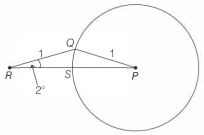
Suppose $Q$ is a point on the circle with centre $P$ and radius $1$, as shown in the figure, $R$ is a point outside the circle such that $Q R=1$ and $\angle Q R P=2^{\circ}$. Let $S$ be the point where the segment $R P$ intersects the given circle. Then, measure of $\angle R Q S$ equals $......^{\circ}$