MCQ
If the measurement errors in all the independent quantities are known, then it is possible to determine the error in any dependent quantity. This is done by the use of series expansion and truncating the expansion at the first power of the error. For example, consider the relation $z=x / y$. If the errors in $x, y$ and $z$ are $\Delta x, \Delta y$ and $\Delta z$, respectively, then

$\mathrm{z} \pm \Delta \mathrm{z}=\frac{\mathrm{x} \pm \Delta \mathrm{x}}{\mathrm{y} \pm \Delta \mathrm{y}}=\frac{\mathrm{x}}{\mathrm{y}}\left(1 \pm \frac{\Delta \mathrm{x}}{\mathrm{x}}\right)\left(1 \pm \frac{\Delta \mathrm{y}}{\mathrm{y}}\right)^{-1} .$

The series expansion for $\left(1 \pm \frac{\Delta y}{y}\right)^{-1}$, to first power in $\Delta y / y$, is $1 \mp(\Delta y / y)$. The relative errors in independent variables are always added. So the error in $\mathrm{z}$ will be $\Delta \mathrm{z}=\mathrm{z}\left(\frac{\Delta \mathrm{x}}{\mathrm{x}}+\frac{\Delta \mathrm{y}}{\mathrm{y}}\right)$.

The above derivation makes the assumption that $\Delta x / x<<1, \Delta \mathrm{y} / \mathrm{y} \ll<1$. Therefore, the higher powers of these quantities are neglected.

($1$) Consider the ratio $\mathrm{r}=\frac{(1-\mathrm{a})}{(1+\mathrm{a})}$ to be determined by measuring a dimensionless quantity a.

If the error in the measurement of $\mathrm{a}$ is $\Delta \mathrm{a}(\Delta \mathrm{a} / \mathrm{a} \ll<1)$, then what is the error $\Delta \mathrm{r}$ in

$(A)$ $\frac{\Delta \mathrm{a}}{(1+\mathrm{a})^2}$ $(B)$ $\frac{2 \Delta \mathrm{a}}{(1+\mathrm{a})^2}$ $(C)$ $\frac{2 \Delta \mathrm{a}}{\left(1-\mathrm{a}^2\right)}$ $(D)$ $\frac{2 \mathrm{a} \Delta \mathrm{a}}{\left(1-\mathrm{a}^2\right)}$

($2$) In an experiment the initial number of radioactive nuclei is $3000$ . It is found that $1000 \pm$ $40$ nuclei decayed in the first $1.0 \mathrm{~s}$. For $|\mathrm{x}| \ll 1$, In $(1+\mathrm{x})=\mathrm{x}$ up to first power in $x$. The error $\Delta \lambda$, in the determination of the decay constant $\lambda$, in $\mathrm{s}^{-1}$, is

$(A) 0.04$    $(B) 0.03$    $(C) 0.02$   $(D) 0.01$

Give the answer quetion ($1$) and ($2$)

  • $B,C$
  • B
    $B,D$
  • C
    $B,A$
  • D
    $B,C,D$

Answer

Correct option: A.
$B,C$
a
($1$) $\mathrm{r}=\frac{1-\mathrm{a}}{1+\mathrm{a}}$

$\frac{\Delta \mathrm{r}}{\mathrm{r}}=\frac{\Delta(1-\mathrm{a})}{(1-\mathrm{a})}+\frac{\Delta(1+\mathrm{a})}{(1+\mathrm{a})}$

$\frac{\Delta \mathrm{r}}{\mathrm{r}}=\frac{\Delta \mathrm{a}}{1-\mathrm{a}}+\frac{\Delta \mathrm{a}}{1+\mathrm{a}}$

$\frac{\Delta \mathrm{r}}{\mathrm{r}}=\frac{2 \Delta \mathrm{a}}{(1-\mathrm{a})(1+\mathrm{a})}$

$\Delta \mathrm{r}=\frac{2(\Delta \mathrm{a})}{(1-\mathrm{a})(1+\mathrm{a})} \times \frac{1-\mathrm{a}}{1+\mathrm{a}}$

$\Delta \mathrm{r}=\frac{2 \Delta \mathrm{a}}{(1+\mathrm{a})^2}$

($2$) $\mathrm{N}=\mathrm{N}_0 \mathrm{e}^{-\lambda \mathrm{t}}$

$\ell \mathrm{nN}=\ell \mathrm{nN}_0-\lambda \mathrm{t}$

Differentiate both sides.

$\frac{\mathrm{dN}}{\mathrm{N}}=-\mathrm{d} \lambda \cdot \mathrm{t}$

(There is no error in calculation of time $t$ )

$\Delta \lambda=\frac{\Delta \mathrm{N}}{\mathrm{N} \times \mathrm{t}}-\frac{40}{2000 \times 1}=0.02$

(where ' $\mathrm{N}$ ' is number of atoms remaining)

Need a full question paper?

Generate a complete, print-ready paper with questions like this in minutes — across 16+ boards, with answer keys.

Start Generating Free

Similar questions

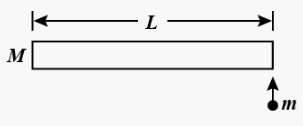
A stick of length $l$ and mass $M$ lies on a frictionless horizontal surface on which it is free to move in any way. A ball of mass $m$ moving with speed $v$ collides elastically with the stick as shown in the figure. If after the collision ball comes to rest, then what should be the mass of the ball
Which of the following material is used to make calorimeter?
$Assertion :$ In free expansion of an ideal gas, the entropy increases.
$Reason :$ Entropy increases in all natural processes.
A circular disc $A$ of radius $r$ is made from an iron plate of thickness $t$ and another circular disc $B$ of radius $4r$ is made from an iron plate of thickness $t/4$. The relation between the moments of inertia ${I_A}$ and ${I_B}$ is
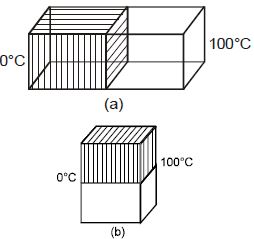
Two identical square rods of metal are welded end to end as shown in figure $(a)$. Assume that $10\, cal$ of heat flows through the rods in $2\, min$. Now the rods are welded as shown in figure, $(b)$. The time it would take for $10$ cal to flow through the rods now, is ........ $\min$
A swimmer can swim with velocity of $12 \,km / h$ in still water. Water flowing in a river has velocity $6\, km / h$. The direction with respect to the direction of flow of river water he should swim in order to reach the point on the other bank just opposite to his starting point is ........$^{\circ}$. (Round off to the Nearest Integer) (find the angle in degree)
A body of mass $10 kg$ is projected at an angle of $45^{\circ}$ with the horizontal. The trajectory of the body is observed to pass through a point $(20,10)$. If $T$ is the time of flight, then its momentum vector, at time $t =\frac{ T }{\sqrt{2}}$, is.

$\left[\right.$ Take $\left.g=10 m / s ^{2}\right]$

The temperature of equal masses of three different liquids ${x}, {y}$ and ${z}$ are $10^{\circ} {C}, 20^{\circ} {C}$ and $30^{\circ} {C}$ respectively. The temperature of mixture when ${x}$ is mixed with ${y}$ is $16^{\circ} {C}$ and that when ${y}$ is mixed with $z$ is $26^{\circ} {C}$. The temperature of mixture when $x$ and $z$ are mixed will be ...... $^{\circ} {C}$
$500\, g$ of water and $100\, g$ of ice at $0\,^oC$ are in a calorimeter whose water equivalent is $40\, g$. $10\, g$ of steam at $100\,^oC$ is added to it. Then water in the calorimeter is ....... $g$ (Latent heat of ice $\,= 80\, cal/g$, Latent heat of steam $\,= 540\, cal/ g$)
Two waves having equations

${x_1} = a\sin (\omega \,t + {\phi _1})$, ${x_2} = a\sin \,(\omega \,t + {\phi _2})$

If in the resultant wave the frequency and amplitude remain equal to those of superimposing waves. Then phase difference between them is