If the period of oscillation of mass $m$ suspended from a spring is $2\, sec$, then the period of mass $4m$ will be .... $\sec$
AIIMS 1998, Medium


Download our appand get started for free
Experience the future of education. Simply download our apps or reach out to us for more information. Let's shape the future of learning together!No signup needed.*
Similar Questions
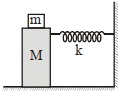
- 1In the given figure, a mass $M$ is attached to a horizontal spring which is fixed on one side to a rigid support. The spring constant of the spring is $k$. The mass oscillates on a frictionless surface with time period $T$ and amplitude $A$. When the mass is in equilibrium position, as shown in the figure, another mass $m$ is gently fixed upon it. The new amplitude of oscillation will beView Solution
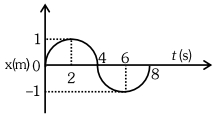
- 2The $x-t$ graph of a particle performing simple harmonic motion is shown in the figure. The acceleration of the particle at $t=2 s$ is :View Solution
- 3A pendulum bob has a speed of $3\, {m} / {s}$ at its lowest position. The pendulum is $50 \,{cm}$ long. The speed of bob, when the length makes an angle of $60^{\circ}$ to the vertical will be $ .......\,{m} / {s}$ $\left(g=10 \,{m} / {s}^{2}\right)$View Solution
- 4Time period of a particle executing $SHM$ is $8\, sec.$ At $t = 0$ it is at the mean position. The ratio of the distance covered by the particle in the $1^{st}$ second to the $2^{nd}$ second is :View Solution
- 5View SolutionIdentify the function which represents a nonperiodic motion.
- 6A particle performs $SHM$ with a period $T$ and amplitude $a.$ The mean velocity of the particle over the time interval during which it travels a distance $a/2$ from the extreme position isView Solution
- 7A particle executes $SHM$ of amplitude $25\, cm$ and time period $3\, s$. What is the minimum time required for the particle to move between two points $12.5\, cm$ on either side of the mean position ..... $\sec$View Solution
- 8The total energy of particle performing $S.H.M.$ depend onView Solution
- 9A spring executes $SHM$ with mass of $10\,kg$ attached to it. The force constant of spring is $10\,N/m$.If at any instant its velocity is $40\,cm/sec$, the displacement will be .... $m$ (where amplitude is $0.5\,m$)View Solution
- 10A particle is executing the motion $x = A\cos (\omega \,t - \theta )$. The maximum velocity of the particle isView Solution