MCQ
If the phase difference between Alternating Voltage and Alternating Current is $\frac{\pi}{6}$​ and the resistance in the circuit is $\sqrt{300}\Omega,$ then the impedance of the circuit will be.
  • A
    $25\Omega$
  • B
    $50\Omega$
  • C
    $20\Omega$
  • D
    $100\Omega$

Answer

  1. $20\Omega$

Explanation:

$\text{impedance}×\cos\theta = \text{resistance}$

$\text{impedance} = \frac{\text{resistance}}{\cos\theta}$

$=\frac{\sqrt{300}}{\frac{\cos\pi}{6}}$

$20\Omega$

Need a full question paper?

Generate a complete, print-ready paper with questions like this in minutes — across 16+ boards, with answer keys.

Start Generating Free

Similar questions

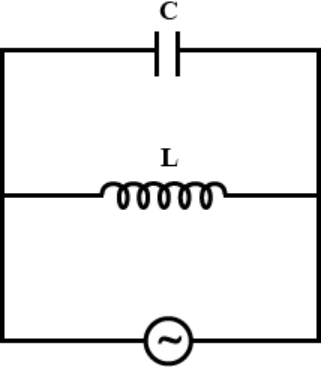
In the AC network shown in figure, the rms current flowing through the inductor and capacitor are 0.6A and 0.8A respectively. Then the current coming out of the source is
Image

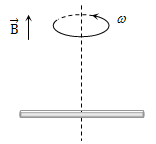
A conducting rod of length 2l is rotating with constant angular speed w about its perpendicular bisector. A uniform magnetic field   exists parallel to the axis of rotation. The e.m.f. induced between two ends of the rod is

(a) Bω    

(b)  Bω

(c)  Bω

(d) Zero

Consider the following two statements A and B and identify the correct choice in the given answer

A :  The characteristic X-ray spectrum depends on the nature of the material of the target.

B :  The short wavelength limit of continuous X-ray spectrum varies inversely with the potential difference applied to the X-rays tube

(a) A is true and B is false

(b) A is false and B is true

(c) Both A  and B  are true

(d) Both A and B are false

Light from a tungsten filament lamp gives:
In the field of electromagnetism, the term 'EMI' stands for:
Alternative current generator is basically based upon:

What kV  potential is to be applied on X-ray tube so that minimum wavelength of emitted  X-rays may be 1Å (h = 6.625  J-sec)

(a) 12.42 kV

(b) 12.84 kV

(c) 11.98 kV

(d) 10.78 kV

Huygens' principle applies :
Which of the following contains a covalent bond?

A straight wire of diameter 0.5 mm carrying a current of 1 A is replaced by another wire of 1 mm diameter carrying the same current. The strength of magnetic field far away is

(a) Twice the earlier value

(b) Half of the earlier value

(c) Quarter of its earlier value

(d) Unchanged