Question
If the potential at each point on a conductor is same to each other, then:

Answer

  1. No electric lines of force may begin or end on the same conductor.
Explanation:
Electric field lines explain the orientation of the electric field in the region and it points tangential to the point at which it is drawn. Thus at any point, the tangent to the electric field line matches the direction of the electric field.
The density of the field lines at a point determines the strength of the electric field at that point.
Therefore, if the potential at each point of the conductor is the same, then it means that there are no electric lines that may begin or end on the conductor.

Need a full question paper?

Generate a complete, print-ready paper with questions like this in minutes — across 16+ boards, with answer keys.
Start Generating Free

Similar questions

The two ends of a uniform conductor are joined to a cell of $e.m.f. E$ and some internal resistance. Starting from the midpoint $P$ of the conductor, we move in the direction of current and return to $P.$ The potential $V$ at every point on the path is plotted against the distance covered $(x).$ Which of the following graphs best represents the resulting curve
The internal energy of an ideal gas decreases by the same amount as the work done by the system:
  1. The process must be adiabatic.
  2. The process must be isothermal.
  3. The process must be isobaric.
  4. The temperature must decrease.
Which of the following is true for number of spectral lines in going form Layman series to Pfund series(a) Increases(b) Decreases(c) Unchanged(d) May decreases or increases
   
   
If the kinetic energy of a free electron doubles, its de$-$Broglie wavelength changes by the factor
A vessel $A$ baa volume $V$ and a vessel $B$ has volume $2V.$ Both contain some water which has a constant volume. The pressure in the space above water is $p_a$ for veesel $A$ and $p_b$ for vessel $B.$
The two alpha particles are released along with energy, when Li-7 is bombarded with a proton. It was found that the mass of the two alpha particles weighs less that the original product in the reaction. Now the mass that was converted to energy is called as:
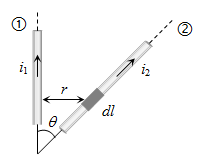
Wires $1$ and $2$ carrying currents $i_1$ and $i_2$ respectively are inclined at an angle $\theta$ to each other. What is the force on a small element dl of wire $2$ at a distance of $r$ from wire $1 ($as shown in figure$)$ due to the magnetic field of wire$1$
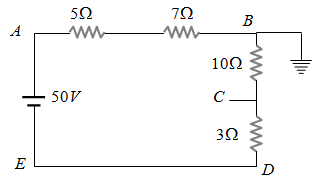
In the circuit shown, the point $‘B\ ’$ is earthed. The potential at the point $‘A\ ’$ is
The refractive indices of glass and water w.r.t. air are 3/2 and 4/3 respectively. The refractive index of glass w.r.t. water will be(a) 8/9(b) 9/8(c) 7/6(d) None of these
       
Two point charges +9e and +e are at 16 cm away from each other. Where should another charge q be placed between them so that the system remains in equilibrium(a) 24 cm from +9e(b) 12 cm from +9e(c) 24 cm from +e(d) 12 cm from +e