- AElectric lines of force may begin or end on the same conductor.
- BNo electric lines of force may begin or end on the same conductor.
- CThe electric field inside the conductor may be non-zero.
- DNone of the above.
Explanation:
Electric field lines explain the orientation of the electric field in the region and it points tangential to the point at which it is drawn. Thus at any point, the tangent to the electric field line matches the direction of the electric field.
The density of the field lines at a point determines the strength of the electric field at that point.
Therefore, if the potential at each point of the conductor is the same, then it means that there are no electric lines that may begin or end on the conductor.
Generate a complete, print-ready paper with questions like this in minutes — across 16+ boards, with answer keys.
The resistance of a cell does not depend on
|
(a) Current drawn from the cell |
(b)Temperature of electrolyte |
|
(c) Concentration of electrolyte |
(d) The e.m.f. of the cell |
Which one of these is non-divisible
|
(a) Nucleus |
(b) Photon |
(c) Proton |
(d) Atom |
The length of a wire of a potentiometer is 100 cm, and the emf of its standard cell is E volt. It is employed to measure the e.m.f of a battery whose internal resistance is 0.5 W. If the balance point is obtained at l = 30 cm from the positive end, the e.m.f. of the battery is (where i is the current in the potentiometer)
|
(a) |
(b) |
(c) |
(d) |
Two point charges +8q and -2q are located at x = 0 and x = L respectively. The location of a point on the x-axis at which the net electric field due to these two point charges is zero is
|
(a) 8 L |
(b) 4 L |
(c) 2 L |
(d) |
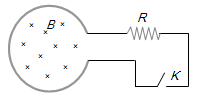
Shown in the figure is a circular loop of radius r and resistance R. A variable magnetic field of induction
is established inside the coil. If the key (K) is closed, the electrical power developed right after closing the switch is equal to

|
(a) |
(b) |
(c) |
(d) |

Which of the following is correct
|
(a) Ammeter has low resistance and is connected in series |
|
(b) Ammeter has low resistance and is connected in parallel |
|
(c) Voltmeter has low resistance and is connected in parallel |
|
(d) None of the above |