- Will remain unchanged.
- Will be doubled.
- Will be halved.
- Will become four times the original.
Explanation:
Cut off wavelength is given by
$\lambda_{\text{min}}=\frac{\text{hc}}{\text{eV}'}$
where h = Planck's constan
c = speed of light
e = charge on an electron
V = potential difference applied to the tube
When potential difference (V) applied to the tube is doubled, cutoff wavelength
$\big({\lambda}'_\text{min}\big)$ is given by
${\lambda}'_\text{min}=\frac{\text{hc}}{\text{e}(2\text{V})}$
$\Rightarrow\lambda'_\text{min}=\frac{\lambda_\text{min}}{2}$
Cuttoff wavelength does not depend on the separation between the filament and the target.
Thus, cutoff wavelength will be halved if the the potential difference applied to the tube is doubled.
Generate a complete, print-ready paper with questions like this in minutes — across 16+ boards, with answer keys.
To produce magnified erect image of a far object, we will be required along with a convex lens, is
|
(a) Another convex lens |
(b) Concave lens |
(c) A plane mirror |
(d) A concave mirror |
A very high magnetic field is applied to a stationary charge. Then the charge experiences
|
(a) A force in the direction of magnetic field |
|
(b) A force perpendicular to the magnetic field |
|
(c) A force in an arbitrary direction |
|
(d) No force |
In a P-type semiconductor, germanium is doped with
|
(a) Boron |
(b) Gallium |
(c) Aluminium |
(d) All of these |
For the structural analysis of crystals, X-rays are used because
|
(a) X-rays have wavelength of the order of interatomic spacing |
|
(b) X-rays are highly penetrating radiations |
|
(c) Wavelength of X-rays is of the order of nuclear size |
|
(d) X-rays are coherent radiations |
The expression for magnetic induction inside a solenoid of length L carrying a current I and having N number of turns is
|
(a) |
(b) |
(c) |
(d) |
In intrinsic semiconductor at room temperature, number of electrons and holes are
|
(a) Unequal |
(b) Equal |
(c) Infinite |
(d) Zero |
Emission spectrum of
gas
|
(a) Is a line spectrum |
(b) Is a band spectrum |
|
(c) Is a continuous spectrum |
(d) Does not fall in the visible region |
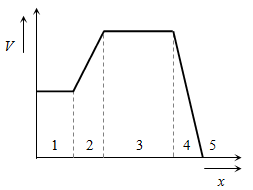
The figure gives the electric potential V as a function of distance through five regions on x-axis. Which of the following is true for the electric field E in these regions

|
(a) |
(b) |
|
(c) |
(d) |