MCQ
If the potential difference applied to the tube is doubled and the separation between the filament and the target is also doubled, the cutoff wavelength:
  • A
    Will remain unchanged.
  • B
    Will be doubled.
  • Will be halved.
  • D
    Will become four times the original.

Answer

Correct option: C.
Will be halved.
Cut off wavelength is given by
$\lambda_{\text{min}}=\frac{\text{hc}}{\text{eV}'}$
where h = Planck's constan
c = speed of light
e = charge on an electron
V = potential difference applied to the tube
When potential difference (V) applied to the tube is doubled, cutoff wavelength
$\big({\lambda}'_\text{min}\big)$ is given by
${\lambda}'_\text{min}=\frac{\text{hc}}{\text{e}(2\text{V})}$
$\Rightarrow\lambda'_\text{min}=\frac{\lambda_\text{min}}{2}$
Cuttoff wavelength does not depend on the separation between the filament and the target.
Thus, cutoff wavelength will be halved if the the potential difference applied to the tube is doubled.

Need a full question paper?

Generate a complete, print-ready paper with questions like this in minutes — across 16+ boards, with answer keys.

Start Generating Free

Similar questions

A rope of length $L$ and uniform linear density is hanging from the ceiling. A transverse wave pulse, generated close to the free end of the rope, travels upwards through the rope. Select the correct option.
A small mass $m$ is launched from the top of a cliff with speed Vat an angle of $30^o$ above the horizontal. When the mass reaches the ground, its velocity is directed at $45^o$ below the horizontal. Which one of the following choices is the magnitude of the total impulse that was imparted to the mass during its flight ? Ignore air resistance
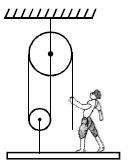
A man of mass $60\ kg$ is standing on a platform of mass $40\ kg$ as shown in figure then what force man should apply on rope so that he accelerate up with the platform with acceleration of $2\ m/s^2$ ............ $N$
A block is at rest on an inclined plane making an angle $\alpha $ with the horizontal. As the angle $\alpha $ of the incline is increased, the block starts slipping when the angle of inclination becomes $\theta $. The coefficient of static friction between the block and the surface of the inclined plane is 
A particle moves along a straight line. Its position at any instant is given by $x=32 t-\frac{8 t^3}{4}$, where $x$ is in metre and $t$ is in second. Find the acceleration of the particle at the instant when particle is at rest $..........\,m / s ^2$
A capillary tube is dipped in water and it is $20 \,cm$ outside water. The water rises upto $8 \,cm$. If the entire arrangement is put in freely falling elevator the length of water column in the capillary tube will be ........ $cm$
Three particles each of mass $m$ are kept at vertices of an equilateral triangle of side $L.$ Th gravitational potential energy possessed by the system is:
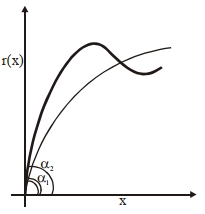
A projectile is launched from the origin in the $xy$ plane ( $x$ is the horizontal and $y$ is the vertically up direction) making an angle $\alpha$ from the $x$-axis. If its distance. $r =\sqrt{ x ^2+ y ^2}$ from the origin is plotted against $x$, the resulting curves show different behaviours for launch angles $\alpha_1$ and $\alpha_2$ as shown in the figure below. For $\alpha_1, r ( x )$ keeps increasing with $x$ while for $\alpha_2$, $r(x)$ increases and reaches a maximum, then decreases and goes through a minimum before increasing again. The switch between these two cases takes place at an angle $\alpha_c\left(\alpha_1 < \alpha_c < \alpha_2\right)$. The value of $\alpha_c$ is [ignore where $v_0$ is the initial speed of the projectile and $g$ is the acceleration due to gravity]
A ball of mass $0.5 \mathrm{~kg}$ is attached to a string of length $50 \mathrm{~cm}$. The ball is rotated on a horizontal circular path about its vertical axis. The maximum tension that the string can bear is $400 \mathrm{~N}$. The maximum possible value of angular velocity of the ball in rad/s is,:
The force required to keep a body in uniform circular motion is