MCQ
If the potential difference applied to the tube is doubled and the separation between the filament and the target is also doubled, the cutoff wavelength:
  • A
    Will remain unchanged.
  • B
    Will be doubled.
  • C
    Will be halved.
  • D
    Will become four times the original.

Answer

  1. Will be halved.

Explanation:

Cut off wavelength is given by

$\lambda_{\text{min}}=\frac{\text{hc}}{\text{eV}'}$

where h = Planck's constan

c = speed of light

e = charge on an electron

V = potential difference applied to the tube

When potential difference (V) applied to the tube is doubled, cutoff wavelength

$\big({\lambda}'_\text{min}\big)$ is given by

${\lambda}'_\text{min}=\frac{\text{hc}}{\text{e}(2\text{V})}$

$\Rightarrow\lambda'_\text{min}=\frac{\lambda_\text{min}}{2}$

Cuttoff wavelength does not depend on the separation between the filament and the target.

Thus, cutoff wavelength will be halved if the the potential difference applied to the tube is doubled.

Need a full question paper?

Generate a complete, print-ready paper with questions like this in minutes — across 16+ boards, with answer keys.

Start Generating Free

Similar questions

A piece of wood is floating in water kept in a bottle. The bottle is connected to an air pump. Neglect the compressibility of water. When more air is pushed into the bottle from the pump, the piece of wood will float with.
  1. Larger part in the water.
  2. Lesser part in the water.
  3. Same part in the water.
  4. It will sink.
The magnetic field at the origin due to a current element $\text{i}\text{d}\ \vec{\text{l}}$ placed at a position $\overrightarrow{\text{r}}$ is:

What is the path difference of destructive interference

(a) nl

(b) n(λ  + 1) 

(c)  

(d)  

Potential energy is the characteristic of the:

Match the List I with the List II from the combination shown. In the left side (List I) there are four different conditions and in the right side (List II), there are ratios of heat produced  in each resistance for each condition :

List I

List II

(I)

Two wires of same resistance are connected in series and same current is passed through them

(A)

1 : 2

(II)

Two wires of resistance R and 2R ohm are connected in series and same P.D. is applied across them

(B)

4 : 1

(III)

Two wires of same resistance are connected in parallel and same  current is flowing through them

(C)

1 : 1

(IV)

Two wires of resistances in the ratio 1 : 2 are connected in parallel and same P.D. is applied across them

(D)

2 : 1

(a) I – B; II – A; III – C; IV - D

(b) I – C; II – D; III – C; IV - D

(c) I – B; II – D; III – A; IV - C

(d) I – A; II – B; III – D; IV - C

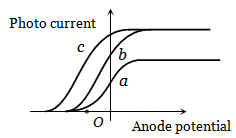
The figure shows the variation of photocurrent with anode potential for a photo-sensitive surface for three different radiations. Let   and  be the intensities and    and   be the frequencies for the curves a, b and c respectively

(a)  and  

(b)  and   

(c)  and  

(d)  and   

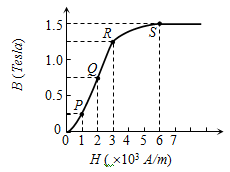
The basic magnetization curve for a ferromagnetic material is shown in figure. Then, the value of relative permeability is highest for the point

(a) P

(b) Q

(c) R

(d) S

A count rate meter shows a count of 240 per minute from a given radioactive source. One hour later the meter shows a count rate of 30 per minute. The half-life of the source is

(a) 120 min

(b) 80 min

(c) 30 min

(d) 20 min

Electric potential of earth is taken to be zero because earth is a good

(a) Insulator

(b) Conductor

(c) Semiconductor

(d) Dielectric

A potentiometer can measure emf of a cell because: