Question
If the radius of a copper wire is doubled, will its specific resistance increase, decrease or remain same?

Answer

The specific resistance of a wire depends only on the material (at a given temperature).
Therefore by changing the radius, the specific resistance of copper remains unchanged.

Need a full question paper?

Generate a complete, print-ready paper with questions like this in minutes — across 16+ boards, with answer keys.
Start Generating Free

Similar questions

Write the name of optical instruments.
A barometer correctly reads the atmospheric pressure as 76cm of mercury. Water droplets are slowly introduced into the barometer tube by a dropper. The height of the mercury column first decreases and then becomes constant. lf the saturation vapour pressure at the atmospheric temperature is 0.80cm of mercury, find the height of the mercury column when it reaches its minimum value.
A light bulb is rated at $100 W$ for a $220 V$ supply. Find (a) the resistance of the bulb; (b) the peak voltage of the source; and (c) the rms current through the bulb.
Derive the equation $($formula$)$ showing the relationship between electric field and electric potential.
Write any four characteristics of electromagnetic wave.
Complete the following decay schemes.
  1. $\text{ }^{226}_{88}\text{Ra}\rightarrow\alpha+$
  2. $\text{ }^{19}_8\text{O}\rightarrow\text{ }^{19}_9\text{F}+$
  3. $\text{ }^{25}_{13}\text{Al}\rightarrow\text{ }^{25}_{12}\text{Mg}+$

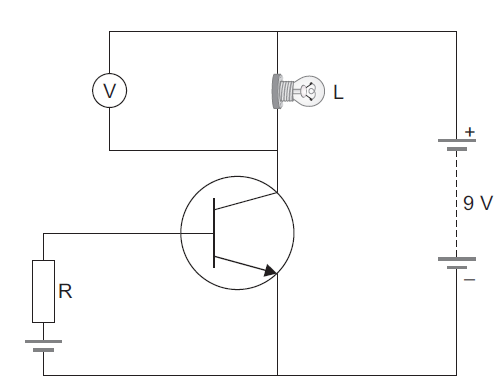
In the given circuit diagram, a voltmeter ‘V’ is connected aross a lamp ’L’. How would (i) the brightness of the lamp and (ii) voltmeter reading ‘V’ be affected, if the value of resistance ‘R’ is decreased? Justify your answer.
The average kinetic energy of molecules in a gas at temperature T is 1.5kT. Find the temperature at which the average kinetic energy of the molecules of hydrogen equals the binding energy of its atoms. Will hydrogen remain in molecular from at this temperature? Take $\mathrm{k}=8.62 \times 10^{-5} \mathrm{eVK}^{-1}$.
Distinguish between polarised and unpolarized light. Does the intensity of polarised light emitted by a Polaroid depend on its orientation? Explain briefly.
The vibrations in a beam of polarised light make an angle of 60° with the axis of the polaroid sheet. What percentage of light is transmitted through the sheet?
The equation $\omega=\frac{\mu_\text{v}-\mu_\text{r}}{\mu-1}$ asderived for a prism having small refracting angle. Is it also valid for a prism of large refracting angle? Is it also valid for a glass slab or a glass sphere?