MCQ
If the resultant of three forces $\vec{\text{F}}_1=\text{p}\hat{\text{i}}+3\hat{\text{j}}-\hat{\text{k}},\ \vec{\text{F}}_2=-5\hat{\text{i}}+2\hat{\text{k}},$ and $\vec{\text{F}}_3=6\hat{\text{i}}-\hat{\text{k}}$ acting on a particle has a magnitude equal to $5$ units, then the value of $p$ is:
  • A
    $-6$
  • B
    $-4$
  • $3$
  • D
    $4$

Answer

Correct option: C.
$3$

Need a full question paper?

Generate a complete, print-ready paper with questions like this in minutes — across 16+ boards, with answer keys.

Start Generating Free

Similar questions

Consider the following two statements $A$ and $B$ and identify the correct choice $(A)$ The torques produced by two forces of couple are opposite to each other. $(B)$ The direction of torque is always perpendicular to plane of rotation of body.
Three musicians experiment with the Doppler effect. Musician $A$ rides in a car at a speed $u$ directly away from musician $B$ who is stationary. Musician $C$ rides in a car directly toward $B$ and travels at the same speed as $A$ . Musician $A$ plays a note at frequency $f_A$ on his trumpet $B$ hears the note, adjusts his trumpet, and plays the same note he heard. Choose the incorrect statement
Two wires are made of the same material and have the same volume. However wire $1$ has crosssectional area $A$ and wire $2$ has cross-section area $3A$. If the length of wire $1$ increases by $\Delta x$ on applying force $F$, how much force is needed to stretch wire $2$ by the same amount?
In an inelastic collision, what is conserved
A hoop of radius $r$ and mass $m$ rotating with an angular velocity $\omega_0$ is placed on a rough horizontal surface. The initial velocity of the centre of the hoop is zero. What will be the velocity of the centre of the hoop when it ceases to slip?
The number of degrees of freedom for translatory motion are:
To increase the frequency from $100Hz$ to $400Hz$ the tension in the string has to be changed by:
Which of the following system of units is not based on units of mass, length and time alone
To increase the angular magnification of a simple microscope, one should increase:
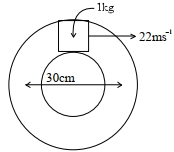
A closed circular tube of average radius $15\,cm$, whose inner walls are rough, is kept in vertical plane. A block of mass $1\,kg$ just fit inside the tube. The speed of block is $22\,m / s$, when it is introduced at the top of tube. After completing five oscillations, the block stops at the bottom region of tube. The work done by the tube on the block is $......J$. [Given $g=10\,m / s ^2$ ]