MCQ
If the shortest distance between the lines

$ \mathrm{L}_1: \overrightarrow{\mathrm{r}}=(2+\lambda) \hat{\mathrm{i}}+(1-3 \lambda) \hat{\mathrm{j}}+(3+4 \lambda) \hat{\mathrm{k}}, \lambda \in \mathbb{R} $

$ \mathrm{L}_2: \overrightarrow{\mathrm{r}}=2(1+\mu) \hat{\mathrm{i}}+3(1+\mu) \hat{\mathrm{j}}+(5+\mu) \hat{k}, \mu \in \mathbb{R}$

is $\frac{\mathrm{m}}{\sqrt{\mathrm{n}}}$, where $\operatorname{gcd}(\mathrm{m}, \mathrm{n})=1$, then the value of $\mathrm{m}+\mathrm{n}$ equals.

  • A
    $384$
  • $387$
  • C
    $377$
  • D
    $390$

Answer

Correct option: B.
$387$
b
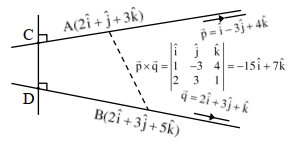
Shortes distance $(\mathrm{CD})=\left|\frac{\overline{\mathrm{AB}} \cdot \overrightarrow{\mathrm{p}} \times \overrightarrow{\mathrm{q}}}{|\overrightarrow{\mathrm{p}} \times \overrightarrow{\mathrm{q}}|}\right|$

$=\left|\frac{(0 \hat{i}+2 \hat{j}+2 \hat{k}) \cdot(-15 \hat{i}+7 \hat{j}+9 \hat{k})}{\sqrt{355}}\right|$

$=\frac{0+14+18}{\sqrt{355}}=\frac{32}{\sqrt{355}}$

$\therefore \mathrm{m}+\mathrm{n}=32+355=387$

Need a full question paper?

Generate a complete, print-ready paper with questions like this in minutes — across 16+ boards, with answer keys.

Start Generating Free

Similar questions

In a workshop, there are five machines and the probability of any one of them to be out of service on a day is $\frac{1}{4} .$ If the probability that at most two machines will be out of service on the same day is $\left(\frac{3}{4}\right)^{3} \mathrm{k},$ then $\mathrm{k}$ is equal to 
If $A=\left(\begin{array}{cc}0 & \sin \alpha \\ \sin \alpha & 0\end{array}\right)$ and $\operatorname{det}\left(A^{2}-\frac{1}{2} I\right)=0,$ then a possible value of $\alpha$ is
The equation of motion of a particle is given by $s = 2{t^3} - 9{t^2} + 12t + 1$, where $s$ and $t$ are measured in $cm$ and $sec$. The time when the particle stops momentarily is
A curve satisfying the initial condition $y(1)= 0$ satisfies the differential equation $x \frac{dy}{dx}= y -x^2$ the area bounded by the curve and the $x$ -axis is
Let $A$ is a square matrix of order $n$ and a being a scalar then $∣aA∣ =$
One hundred idential coins, each with probability p of showing heads are tossed once. If $0 < p < 1$ and the probability of heads showing on $50$ coins is equal to that of heads showing on $51$ coins, the value of $p$ is :
For which value of $x$, are the determinants $\left|\begin{array}{ll}2 x & -3 \\ 5 & x\end{array}\right|$ and $\left|\begin{array}{cc}10 & 1 \\ -3 & 2\end{array}\right|$ equal?
The number of integral solutions $(x, y)$ of the equations $\text{x}{\sqrt{\text{y}}}+\text{y}\sqrt{\text{x}}=20$ and $\text{x}{\sqrt{\text{x}}}+\text{y}\sqrt{\text{y}}=65$ is:
Find the value of $x,\,y$ and $z$ from the following equation : $\left[\begin{array}{ll}x+y & 2 \\ 5+z & x y\end{array}\right]=\left[\begin{array}{ll}6 & 2 \\ 5 & 8\end{array}\right]$
The general solution of the differential equation $x d y-\left(1+x^2\right) d x=d x$ is :