MCQ
If the valency shell electronic structure for an element is $n{s^2}n{p^5}$, this element will belong to the group of
  • A
    Alkali metals
  • B
    Inert metals
  • C
    Noble gases
  • Halogens

Answer

Correct option: D.
Halogens
d
The valence shell or orbital electronic configuration of halogens($17^{th}$ group elements) is $n s^2 \,n p^5$.

Need a full question paper?

Generate a complete, print-ready paper with questions like this in minutes — across 16+ boards, with answer keys.

Start Generating Free

Similar questions

Consider the following statements
$I.$ The radius of an anion is larger than that of the parent atom.

$II.$ The ionization energy generally increases with increasing atomic number in a period.

$III.$ The electronegativity of an element is the tendency of an isolated atom to attract an electron.

Which of the above statements is/are correct?

In

$CH _{2} = C = C H - C H _{3}$

$\quad 1\quad \quad 2\quad \quad 3\quad \quad \quad 4$

molecule, the hybridization of carbon $1,2,3$ and $4$ respectively are :

$\mathop {C{H_2}}\limits_{(I)}  = O \leftrightarrow \mathop {{}^ \oplus C{H_2}}\limits_{(II)}  - {O^\circleddash } \leftrightarrow \mathop {{}^\circleddash C{H_2}}\limits_{(III)}  - {O^ \oplus }$

Which of these structures is practically not a valid canonical structure for formaldehyde ?
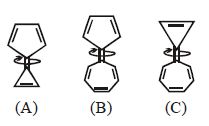
Compare carbon-carbon bond rotation energy across $A, B$ and $C$ 
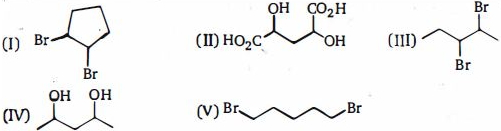
A compound was synthesized by a student, but its structure was not identified.  However, his wonderfully helpful instructor told him that it was a meso compound with $5$ carbons and $2$ stereogenic centers. Which of the following structures  should the student consider as possibilities for his compound ?
Match the column?
Column $-I$ Column $-II$
$(A)$ Ionisation potential $(P)\;  O < F < N$
$(B)$ Electronegativity $(Q)\;  N < O < F$
$(C) \;Z_{eff}$ $(R) \;O < N < F$
$(D)$ Electron affinity $(S)\; N < C< O$
In Carius method of estimation of halogen. $0.45\,g$ of an organic compound gave $0.36\,g$ of $AgBr$. Find out the percentage of bromine in the compound.Molar masses : $AgBr =188 g mol ^{-1}: Br =80 g mol ^{-1}$ )
Which of the following explains the sequence of filling the electrons in different shells
In which of the following hydrogen bond is present
The oxidation state of nitrogen is highest in