Question
If there is a statement involving the natural number n such that:
  1. The statement is true for $n = 1$
  2. When the statement is true for $n = k ($where $k$ is some positive integer$),$ then the statement is also true for $n = k + 1.$
Then, the statement is true for all natural numbers n.
Also, if $A$ is a square matrix of order n, then $A^2$ is defined as $AA$. In general, $A^m = AA .... A (m$ times$)$. where m is any positive integer.
Based on the above information, answer the following questions.
  1. If $\text{A}=\begin{bmatrix}3&-4\\1&-1\end{bmatrix},$ then for any positive integer n,
  1. $\text{A}^\text{n}=\begin{bmatrix}3\text{n}&-4\text{n}\\\text{n}&-\text{n}\end{bmatrix}$
  2. $\text{A}^\text{n}=\begin{bmatrix}1+2\text{n}&-4\text{n}\\\text{n}&1-2\text{n}\end{bmatrix}$
  3. $\text{A}^\text{n}=\begin{bmatrix}3\text{n}&-8\text{n}\\1&-\text{n}\end{bmatrix}$
  4. $\text{A}^\text{n}=\begin{bmatrix}1+3\text{n}&-4\text{n}\\\text{n}&1-3\text{n}\end{bmatrix}$
  1. If $\text{A}=\begin{bmatrix}1&2\\0&1\end{bmatrix},$ then $|A^n|$, where $\text{n}\in\text{ N},$ is equal to:
  1. $2^n$
  2. $3^n$
  3. $n$
  4. $1$
  1. If $\text{A}=\begin{bmatrix}1&0\\1&1\end{bmatrix}$ and $\text{I}=\begin{bmatrix}1&0\\0&1\end{bmatrix}$ then which of the following holds for all natural numbers $\text{n}\geq1?$
  1. $A^n= nA - (n - 1)I$
  2. $A^n = 2^{n-1} A - (n - 1)I$
  3. $A^n= nA + (n - 1)I$
  4. $A^n = 2^{n-1} A + (n - 1)I$
  1. Let $\text{A}=\begin{bmatrix}\text{a}&0&0\\0&\text{a}&0\\0&0&\text{a}\end{bmatrix}$ and $\text{A}^\text{n}=[\text{a}_{\text{ij}}]_{3\times3}$ for some positive integer n, then the cofactor of $a_{13}$ is:
  1. $a^n$
  2. $-a^n$
  3. $2a^n$
  4. $0$
  1. If $A$ is a square matrix such that $|A| = 2,$ then for any positive integer n, $|A^n|$ is equal to:
  1. $0$
  2. $2n$
  3. $2^n$
  4. $n^2$

Answer

  1. (b) $\text{A}^\text{n}=\begin{bmatrix}1+2\text{n}&-4\text{n}\\\text{n}&1-2\text{n}\end{bmatrix}$
Solution:
We have, $\text{A}=\begin{bmatrix}3&-4\\1&-1\end{bmatrix}$
$\therefore\text{A}^2=\begin{bmatrix}3&-4\\1&-1\end{bmatrix}\begin{bmatrix}3&-4\\1&-1\end{bmatrix}=\begin{bmatrix}5&-8\\2&-3\end{bmatrix},$ which can be obtained from $\text{A}^\text{n}=\begin{bmatrix}1+2\text{n}&-4\text{n}\\\text{n}&1-2\text{n}\end{bmatrix}$ for $n = 2.$
  1. (d) $1$
Solution:
We have, $\text{A}=\begin{bmatrix}1&2\\0&1\end{bmatrix}$
$\therefore|\text{A}|=\begin{vmatrix}1&2\\0&1\end{vmatrix}=1-0=1$
Also, $|A^n| = |A· A ...... A(n$ times$)| = |A|^n = 1^n = 1$
  1. (a) $A^n= nA - (n - 1)I$
Solution:
For $n = 1,$ all options are true.
$\text{A}^2=\text{A}\cdot\text{A}=\begin{bmatrix}1&0\\1&1\end{bmatrix}\begin{bmatrix}1&0\\1&1\end{bmatrix}=\begin{bmatrix}1&0\\2&1\end{bmatrix}$
and $\text{A}^3=\text{A}^2\cdot\text{A}=\begin{bmatrix}1&0\\2&1\end{bmatrix}\begin{bmatrix}1&0\\1&1\end{bmatrix}=\begin{bmatrix}1&0\\3&1\end{bmatrix}$
Putting $n = 3$, in $(a),$ we get $A^3 = 3A - 2I$
$=3\begin{bmatrix}1&0\\1&1\end{bmatrix}-\begin{bmatrix}2&0\\0&2\end{bmatrix}$
$=\begin{bmatrix}3&0\\3&3\end{bmatrix}-\begin{bmatrix}2&0\\0&2\end{bmatrix}=\begin{bmatrix}1&0\\3&1\end{bmatrix},$ which is true.
All other options are different from $A^3 = 3A -2I$ for $n = 3.$
  1. (d) $0$
Solution:
We have, $\text{A}=\begin{bmatrix}\text{a}&0&0\\0&\text{a}&0\\0&0&\text{a}\end{bmatrix}$
$\therefore\text{A}^2=\text{A}\cdot\text{A}=\begin{bmatrix}\text{a}&0&0\\0&\text{a}&0\\0&0&\text{a}\end{bmatrix}\begin{bmatrix}\text{a}&0&0\\0&\text{a}&0\\0&0&\text{a}\end{bmatrix}$
$=\begin{bmatrix}\text{a}^2&0&0\\0&\text{a}^2&0\\0&0&\text{a}^2\end{bmatrix}$
Similarly, $\text{A}^\text{n}=\begin{bmatrix}\text{a}^\text{n}&0&0\\0&\text{a}^\text{n}&0\\0&0&\text{a}^\text{n}\end{bmatrix}$
Now, cofactor of $\text{a}_{13}=(-1)^{1+3}\begin{vmatrix}0&\text{a}^\text{n}\\0&0\end{vmatrix}=0$
  1. (c) $2^n$​​​​​​​
Solution:
We have, $|A| = 2$ and $|A^n| = |A·A ...... A(n- $ times$)|$
$= |A| |A| ...... |A|(n -$ times$) = |A|^n = 2^n$​​​​​​​

Need a full question paper?

Generate a complete, print-ready paper with questions like this in minutes — across 16+ boards, with answer keys.

Start Generating Free

Similar questions

If the equation is of the form $\frac{\text{dy}}{\text{dx}}=\text{py}=\text{Q},$ where P, Q are functions of x, then the solution of the differential equation is given by $\text{ye}^{\int\text{pdx}}=\int\text{Q e}^{\int\text{pdx}}\text{dx}+\text{c},$ where $\text{e}^{\int\text{pdx}}$ is called the integrating factor (I.F.).
Based on the above information, answer the following questions.
  1. The integrating factor of the differential equation $\sin\text{x}\frac{\text{dy}}{\text{dx}}+2\text{y}\cos\text{x}=1$ is $(\sin\text{x})^\lambda,$ where $\lambda=$
  1. 0
  2. 1
  3. 2
  4. 3
  1. Integrating factor of the differential equation $(1-\text{x}^2)\frac{\text{dy}}{\text{dx}}-\text{xy}=1$ is:
  1. $-\text{x}$
  2. $\frac{\text{x}}{1+\text{x}^2}$
  3. $\sqrt{1-\text{x}^2}$
  4. $\frac{1}{2}\log(1-\text{x}^2)$
  1. The solution of $\frac{\text{dy}}{\text{dx}}+\text{y}=\text{e}^{-\text{x}},\text{ y}(0)=0,$ is:
  1. $\text{y}=\text{e}^\text{x}(\text{x}-1)$
  2. $\text{y}=\text{xe}^{-\text{x}}$
  3. $\text{y}=\text{xe}^{-\text{x}}+1$
  4. $\text{y}=(\text{x}+1)\text{e}^{-\text{x}}$
  1. General solution of $\frac{\text{dy}}{\text{dx}}+\text{y}\tan\text{x}=\sec\text{x}$ is:
  1. $\text{y}\sec\text{y}=\tan\text{x}+\text{c}$
  2. $\text{y}\tan\text{x}=\sec\text{x}+\text{c}$
  3. $\tan\text{x}=\text{y}\tan\text{x}+\text{c}$
  4. $\text{x}\sec\text{x}=\tan\text{y}+\text{c}$
  1. The integrating factor of differential equation $\frac{\text{dy}}{\text{dx}}-3\text{y}=\sin2\text{x}$ is:
  1. $\text{e}^{3\text{x}}$
  2. $\text{e}^{-2\text{x}}$
  3. $\text{e}^{-3\text{x}}$
  4. $\text{xe}^{-3\text{x}}$
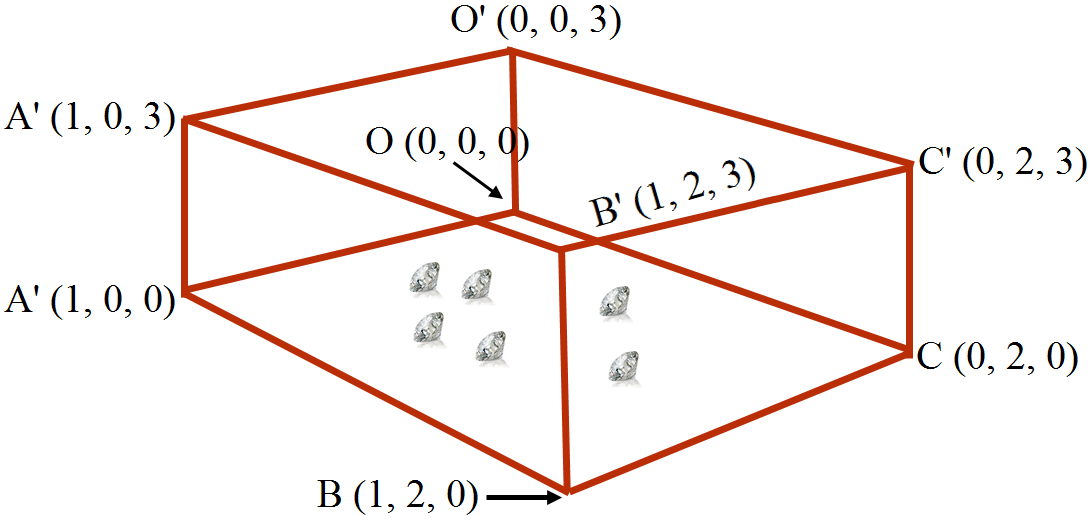
In a diamond exhibition, a diamond is covered in cubical glass box having coordinates O(0, 0, 0), A(1, 0, 0), B(1, 2, 0), C(0, 2, 0), O'(0, 0, 3), A'(1, 0, 3), B'(1, 2, 3) and C'(0, 2, 3). Based on the above information, answer the following questions.

  1. Direction ratios of OA are:
  1. < 0, 1, 0 >
  2. < 1, 0, 0 >
  3. < 0, 0, 1 >
  4. None of these
  1. Equation of diagonal OB' is:
  1. $\frac{\text{x}}{1}=\frac{\text{y}}{2}=\frac{\text{z}}{3}$
  2. $\frac{\text{x}}{0}=\frac{\text{y}}{1}=\frac{\text{z}}{2}$
  3. $\frac{\text{x}}{1}=\frac{\text{y}}{0}=\frac{\text{z}}{2}$
  4. None of these
  1. Equation of plane OABC is:
  1. x = 0
  2. y = 0
  3. z = 0
  4. None of these
  1. Equation of plane O' A' B' C' is:
  1. x = 3
  2. y = 3
  3. z = 3
  4. z = 2
  1. Equation of plane ABB' A' is:
  1. x = 1
  2. y = 1
  3. z = 2
  4. x = 3
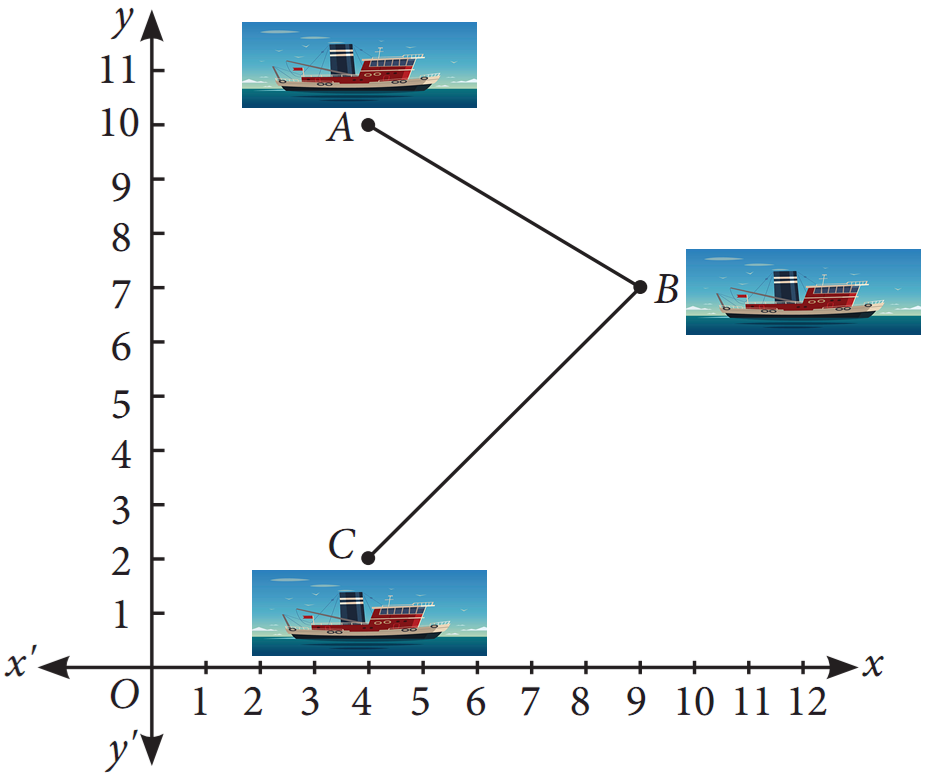
A barge is pulled into harbour by two tug boats as shown in the figure.
Based on the above information, answer the following questions.

  1. Position vector of A is:
  1. $4\hat{\text{i}}+2\hat{\text{j}}$
  2. $4\hat{\text{i}}+10\hat{\text{j}}$
  3. $4\hat{\text{i}}-10\hat{\text{j}}$
  4. $4\hat{\text{i}}-2\hat{\text{j}}$
  1. Position vector of B is:
  1. $4\hat{\text{i}}+4\hat{\text{j}}$
  2. $6\hat{\text{i}}+6\hat{\text{j}}$
  3. $9\hat{\text{i}}+7\hat{\text{j}}$
  4. $3\hat{\text{i}}+3\hat{\text{j}}$
  1. Find the vector $\overline{\text{AC}}$ in terms of $\hat{\text{i}},\hat{\text{j}}.$
  1. $8\hat{\text{j}}$
  2. $-8\hat{\text{j}}$
  3. $8\hat{\text{i}}$
  4. None of these
  1. If $\vec{\text{A}}=\hat{\text{i}}+2\hat{\text{j}}+3\hat{\text{k}},$ then its unit vector is:
  1. $\frac{\hat{\text{i}}}{\sqrt{14}}+\frac{2\hat{\text{j}}}{\sqrt{14}}+\frac{3\hat{\text{k}}}{\sqrt{14}}$
  2. $\frac{3\hat{\text{i}}}{\sqrt{14}}+\frac{2\hat{\text{j}}}{\sqrt{14}}+\frac{\hat{\text{k}}}{\sqrt{14}}$
  3. $\frac{2\hat{\text{i}}}{\sqrt{14}}+\frac{3\hat{\text{j}}}{\sqrt{14}}+\frac{\hat{\text{k}}}{\sqrt{14}}$
  4. None of these
  1. If $\vec{\text{A}}=4\hat{\text{i}}+3\hat{\text{j}}$ and $\vec{\text{B}}=3\hat{\text{i}}+4\hat{\text{j}},$ then $|\vec{\text{A}}|+|\vec{\text{B}}|=$
  1. 12
  2. 13
  3. 14
  4. 10
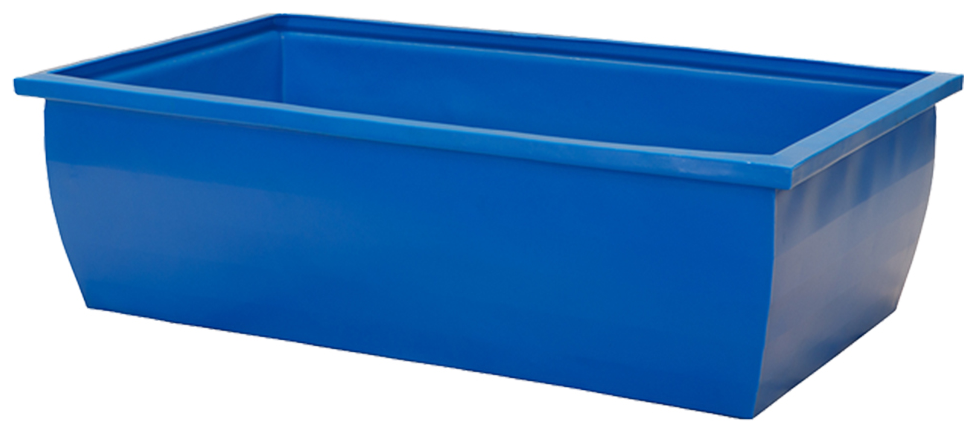
Nitin wants to construct a rectangular plastic tank for his house that can hold $80\ ft^3$ of water. The top of the tank is open. The width of tank will be $5$ ft but the length and heights are variables. Building the tank cost? $₹\ 20$ per sq. foot for the base and $₹\ 10$ per sq. foot for the side.

Based on the above information, answer the following questions.
  1. In order to make a least expensive water tank, Nitin need to minimize its.
  1. Volume
  2. Base
  3. Curved surface area
  4. Cost
  1. Total cost of tank as a function of h can be represented as.
  1. $c(h) = 100h - 320 - 1600/ h$
  2. $c(h) = 100h - 320h - 720h^2$
  3. $c(h) = 100 + 320h + 1600h^2$
  4. $\text{c}\big(\text{h}\big)=100\text{h}+320+\frac{1600}{\text{h}}$
  1. Range of $h$ is.
  1. $(3, 5)$
  2. $\big(0,\infty\big)$
  3. $(0, 8)$
  4. $(0, 3)$
  1. Value of hat which $c(h)$ is minimum, is.
  1. $4$
  2. $5$
  3. $6$
  4. $6, 7$
  1. The cost of least expensive tank is.
  1. $₹\ 1020$
  2. $₹\ 1100$
  3. $₹\ 1120$
  4. $₹\ 1220$
On a holiday, a father gave a puzzle from a newspaper to his son Ravi and his daughter Priya. The probability of solving this specific puzzle independently by Ravi and Priya are $\frac{1}{4}$ and $\frac{1}{5}$ respectively.

Based on the above information, answer the following questions.

  1. The chance that both Ravi and Priya solved the puzzle, is:
  1. $10\%$
  2. $5\%$
  3. $20\%$
  4. $25\%$
  1. Probability that puzzle is solved by Ravi but not by Priya, is:
  1. $\frac{1}{2}$
  2. $\frac{1}{5}$
  3. $\frac{3}{5}$
  4. $\frac{1}{3}$
  1. Find the probability that puzzle is solved.
  1. $\frac{1}{2}$
  2. $\frac{1}{5}$
  3. $\frac{2}{5}$
  4. $\frac{5}{6}$
  1. Probability that exactly one of them solved the puzzle, is:
  1. $\frac{1}{30}$
  2. $\frac{1}{20}$
  3. $\frac{7}{20}$
  4. $\frac{3}{20}$
  1. Probability that none of them solved the puzzle, is:
  1. $\frac{1}{5}$
  2. $\frac{3}{5}$
  3. $\frac{2}{5}$
  4. None of these
Western music concert is organised every year in the stadium that can hold 36000 spectators. With ticket price of ₹ 10, the average attendance has been 24000. Some financial expert estimated that price of a ticket should be determined by the function.
$\text{p}(\text{x})=15-\frac{\text{x}}{3000}$ where x is the number of tickets sold.

Based on the above information, answer the following questions.
  1. The revenue, R as a function of x can be represented as.
  1. $15\text{x}-\frac{\text{x}^2}{3000}$
  2. $15-\frac{\text{x}^2}{3000}$
  3. $15\text{x}-\frac{1}{3000}$
  4. $15\text{x}-\frac{\text{x}}{3000}$
  1. The range of x is.
  1. [24000, 36000]
  2. [0, 24000]
  3. [0, 36000]
  4. None of these
  1. The value of x for which revenue is maximum, is.
  1. 20000
  2. 21000
  3. 22500
  4. 25000
  1. When the revenue is maximum, the price of the ticket is.
  1. ₹ 5
  2. ₹ 5.5
  3. ₹ 7
  4. ₹ 7.5
  1. How many spectators should be present to maximize the revenue?
  1. 21500
  2. 21000
  3. 22000
  4. 22500
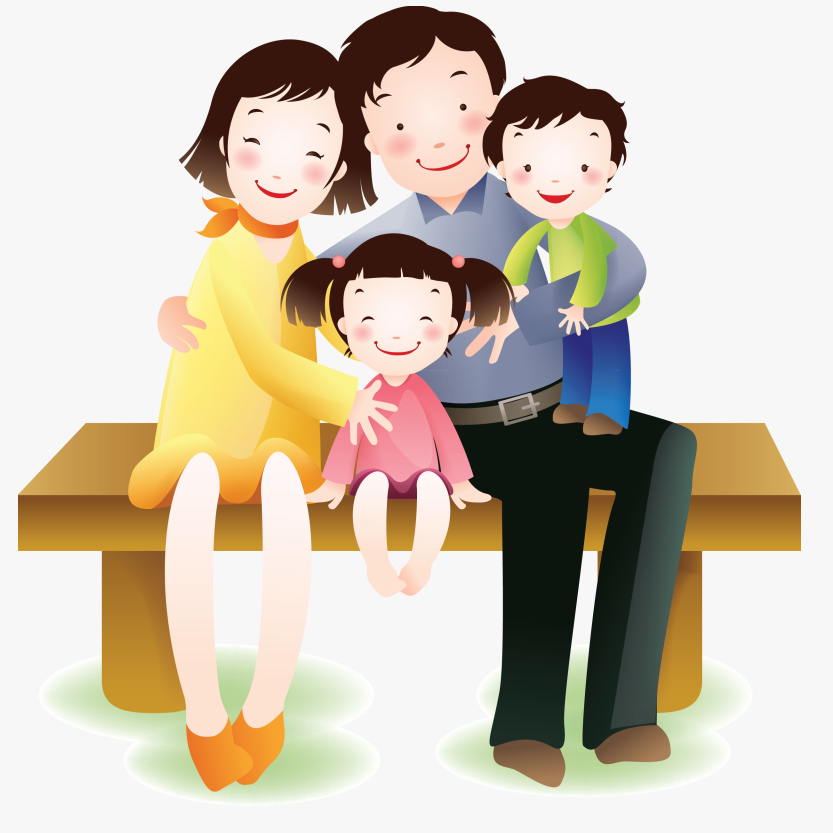
In a wedding ceremony, consists of father, mother, daughter and son line up at random for a family photograph, as shown in figure.
Based on the above information, answer the following questions.

  1. Find the probability that daughter is at one end, given that father and mother are in the middle.
  1. $1$
  2. $\frac{1}{2}$
  3. $\frac{1}{3}$
  4. $\frac{2}{3}$
  1. Find the probability that mother is at right end, given that son and daughter are together.
  1. $\frac{1}{2}$
  2. $\frac{1}{3}$
  3. $\frac{1}{4}$
  4. $0$
  1. Find the probability that father and mother are in the middle, given that son is at right end.
  1. $\frac{1}{4}$
  2. $\frac{1}{2}$
  3. $\frac{1}{3}$
  4. $\frac{2}{3}$
  1. Find the probability that father and son are standing together, given that mother and daughter are standing together.
  1. $0$
  2. $1$
  3. $\frac{1}{2}$
  4. $\frac{2}{3}$
  1. Find the probability that father and mother are on either of the ends, given that son is at second position from the right end.
  1. $\frac{1}{3}$
  2. $\frac{2}{3}$
  3. $\frac{1}{4}$
  4. $\frac{2}{5}$
In a family there are four children. All of them have to work in their family business to earn their livelihood at the age of 18. Based on the above information, answer the following questions.
  1. Probability that all children are girls, if it is given that elder child is a boy, is:
  1. $\frac{3}{8}$
  2. $\frac{1}{8}$
  3. $\frac{5}{8}$
  4. None of these.
  1. Probability that all children are boys, if two elder children are boys, is:
  1. $\frac{1}{4}$
  2. $\frac{3}{4}$
  3. $\frac{1}{2}$
  4. None of these.
  1. Find the probability that two middle children are boys, if it is given that eldest child is a girl.
  1. $0$
  2. $\frac{3}{4}$
  3. $\frac{1}{4}$
  4. None of these.
  1. Find the probability that all children are boys, if it is given that at most one of the children is a girl.
  1. $0$
  2. $\frac{1}{5}$
  3. $\frac{2}{5}$
  4. $\frac{4}{5}$
  1. Find the probability that all children are boys, if it is given that at least three of the children are boys.
  1. $\frac{1}{5}$
  2. $\frac{2}{5}$
  3. $\frac{3}{5}$
  4. $\frac{4}{5}$
In a play zone, Aastha is playing crane game. It has 12 blue balls, 8 red balls, 10 yellow balls and 5 green balls. If Aastha draws two balls one after the other without replacement, then answer the following questions.
  1. What is the probability that the first ball is blue and the second ball is green?
  1. $\frac{5}{119}$
  2. $\frac{12}{119}$
  3. $\frac{6}{119}$
  4. $\frac{15}{119}$
  1. What is the probability that the first ball is yellow and the second ball is red?
  1. $\frac{16}{119}$
  2. $\frac{8}{119}$
  3. $\frac{24}{119}$
  4. None of these.
  1. What is the probability that both the balls are red?
  1. $\frac{4}{85}$
  2. $\frac{24}{595}$
  3. $\frac{12}{119}$
  4. $\frac{64}{119}$
  1. What is the probability that the first ball is green and the second ball is not yellow?
  1. $\frac{10}{119}$
  2. $\frac{6}{85}$
  3. $\frac{12}{119}$
  4. None of these.
  1. What is the probability that both the balls are not blue?
  1. $\frac{6}{595}$
  2. $\frac{12}{85}$
  3. $\frac{15}{17}$
  4. $\frac{253}{595}$
A rumour on whatsapp spreads in a population of 5000 people at a rate proportional to the product of the number of people who have heard it and the number of people who have not. Also, it is given that 100 people initiate the rumour and a total of 500 people know the rumour after 2 days.

Based on the above information, answer the following questions.
  1. If y(t) denote the number of people who know the rumour at an instant t, then maximum value of y(t) is:
  1. 500
  2. 100
  3. 5000
  4. None of these
  1. $\frac{\text{dn}}{\text{dt}}$ is proportional to:
  1. (y - 5000)
  2. y(y - 500)
  3. y(500 - y)
  4. y(5000 - y)
  1. The value of y(0) is:
  1. 100
  2. 500
  3. 600
  4. 200
  1. The value of y(2) is:
  1. 100
  2. 500
  3. 600
  4. 200
  1. The value of y at any time t is given by:
  1. $\text{y}=\frac{5000}{_\text{e}-5000\text{kt}_{+1}}$
  2. $\text{y}=\frac{5000}{_\text{1+e}-5000\text{kt}}$
  3. $\text{y}=\frac{5000}{_\text{49e}-5000\text{kt}_{+1}}$
  4. $\text{y}=\frac{5000}{_\text{49}{(_\text{1+e}}-5000\text{kt})}$