MCQ
If threshold wavelength for sodium is $6800 \mathring A$ then the work function will be
  • $1.8 \mathrm{eV}$
  • B
    $2.5 \mathrm{eV}$
  • C
    $2.1 \mathrm{eV}$
  • D
    $1.4 \mathrm{eV}$

Answer

Correct option: A.
$1.8 \mathrm{eV}$
$W_0=\frac{12375}{6800}=1.8 \mathrm{eV}$

Need a full question paper?

Generate a complete, print-ready paper with questions like this in minutes — across 16+ boards, with answer keys.
Start Generating Free

Similar questions

In a grease spot photometer light from a lamp with dirty chimney is exactly balanced by a point source distance $10 \mathrm{~cm}$ from the grease spot. On clearing the chimney, the point source is moved $2 \mathrm{~cm}$ to obtain balance again. The percentage of light absorbed by dirty chimney is nearly
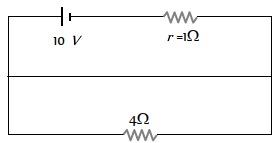
Potential difference across the terminals of the battery shown in figure is $(r=$ internal resistance of battery)

Image

The coefficient of performance of a Carnot refrigerator working between $30^{\circ} \mathrm{C}$ and $0^{\circ} \mathrm{C}$ is
The wiring of a house has resistance $6 \Omega$. A $100 W$ bulb is glowing. If a geyser of $1000 W$ is switched on, the change in potential drop across the bulb is nearly
A transverse wave is given by $y=A \sin 2 \pi\left(\frac{t}{T}-\frac{x}{\lambda}\right)$. The maximum particle velocity is equal to 4 times the wave velocity when
The hottest planet of solar system is
A photon of energy $8 \mathrm{eV}$ is incident on metal surface of threshold frequency $1.6 \times 10^{15} \mathrm{~Hz}$. The maximum kinetic energy of the photoelectrons emitted (in eV) (Take $h=6 \times 10^{-34}$ JS).
A potentiometer consists of a wire of length $4 \mathrm{~m}$ and resistance $10 \Omega$. It is connected to a cell of e.m.f. $2 \mathrm{~V}$. The potential difference per unit length of the wire will be
Velocity of light in glass whose refractive index with respect to air is $1.5$ is $2 \times 10 \mathrm{~m} / \mathrm{s}$ and in certain liquid the velocity of light found to be $2.5 \times 10 \mathrm{~m} / \mathrm{s}$. The refractive index of the liquid with respect to air is
A Carnot engine absorbs an amount $Q$ of heat from a reservoir at an abosolute temperature $T$ and rejects heat to a sink at a temperature of $T / 3$. The amount of heat rejected is