MCQ
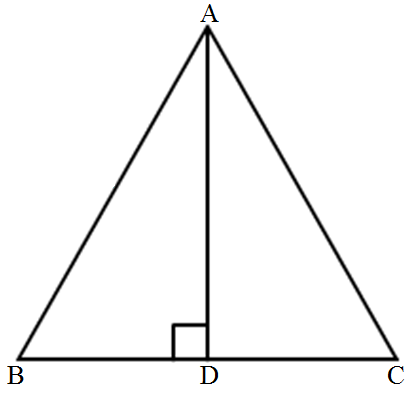
If $\triangle\text{ABC}$ is an equilateral triangle such that $\text{AD}\perp\text{BC},$ then $AD^2 =$
  • A
    $\frac{3}{2}\text{DC}^2$
  • B
    $\text{2DC}^2$
  • $3\text{CD}^2$
  • D
    $4\text{DC}^2$

Answer

Correct option: C.
$3\text{CD}^2$
In equilateral $\triangle\text{ABC},\ \text{AD}\perp\text{BC}$
$AD$ bisects $BC$ at $D$

$\therefore B D=D C$
Now in right $ \triangle A D C,$
$A C^2=A D^2+D C^2(\text { Pythagoras Theorem })$
$A D^2=A C^2-D C^2$
$=B C^2-D C^2(\because A C=B C=A B)$
$=(2 D C)^2-D C^2(\because D \text { is mid point of } B C)$
$=4 D C^2-D C^2=3 D C^2$
$=3 C D^2$

Need a full question paper?

Generate a complete, print-ready paper with questions like this in minutes — across 16+ boards, with answer keys.
Start Generating Free