MCQ
If $u = \sqrt {{a^2}{{\cos }^2}\theta + {b^2}{{\sin }^2}\theta } + \sqrt {{a^2}{{\sin }^2}\theta + {b^2}{{\cos }^2}\theta } $, then difference between the maximum and minimum values of ${u^2}$ is given by
  • ${(a - b)^2}$
  • B
    $2\sqrt {{a^2} + {b^2}} $
  • C
    ${(a + b)^2}$
  • D
    $2({a^2} + {b^2})$

Answer

Correct option: A.
${(a - b)^2}$
a
(a) $2u = \sqrt {{a^2}{{\cos }^2}\theta + {b^2}{{\sin }^2}\theta } + \sqrt {{a^2}{{\sin }^2}\theta + {b^2}{{\cos }^2}\theta } $
${u^2} = {a^2} + {b^2} + 2\sqrt {({a^2}{{\cos }^2}\theta + {b^2}{{\sin }^2}\theta )({a^2}{{\sin }^2}\theta + {b^2}{{\cos }^2}\theta )} $
$ = {a^2} + {b^2} + 2\sqrt {t({a^2} + {b^2} - t)} $
$ = {a^2} + {b^2} + 2\sqrt { - {t^2} + ({a^2} + {b^2})t} $
where $t = {a^2}{\cos ^2}\theta + {b^2}{\sin ^2}\theta ,\,({a^2} > {b^2})$
${t_{\max }} = {a^2}$ and ${t_{\min }} = {b^2}.$
Let $y = - {t^2} + ({a^2} + {b^2})t$
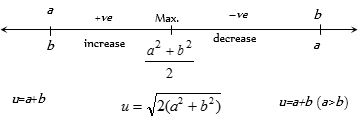
Now $\frac{{dy}}{{dt}} = 0 \Rightarrow - 2t + ({a^2} + {b^2}) = 0 \Rightarrow t = \frac{{{a^2} + {b^2}}}{2}$
Sign scheme for $\frac{{dy}}{{dt}}$
$\therefore$ ${({u_{\max }})^2} - {({u_{\min }})^2} = 2({a^2} + {b^2}) - {(a + b)^2} = {(a - b)^2}$

Need a full question paper?

Generate a complete, print-ready paper with questions like this in minutes — across 16+ boards, with answer keys.

Start Generating Free

Similar questions

Let $f(x)=\sqrt{\lim _{r \rightarrow x}\left\{\frac{2 r^2\left[(f(r))^2-f(x) f(r)\right]}{r^2-x^2}-r^3 e^{\frac{f(r)}{r}}\right\}}$ be differentiable in $(-\infty, 0) \cup(0, \infty)$ and $f(1)=1$. Then the value of $ea$, such that $f(a)=0$, is equal to.............
If  $ A, B, C, D$  are any four points in space, then $|\overrightarrow {AB} \times \overrightarrow {CD} + \overrightarrow {BC} \times \overrightarrow {AD} + \overrightarrow {CA} \times \overrightarrow {BD} |$ is equal to           (where $Delta$ denotes the area of $\Delta ABC$)
If $f\left( x \right) = {\left( {\frac{3}{5}} \right)^x} + {\left( {\frac{4}{5}} \right)^x} - 1$ , $x \in R$ , then the equation $f(x) = 0$ has
The area of the smaller region enclosed by the curves $y ^{2}=8 x +4$ and $x^{2}+y^{2}+4 \sqrt{3} x-4=0$ is equal to.
If $f\left( x \right) = \left[ x \right] - \left[ {\frac{x}{4}} \right],\,x \in R$ , where $[x]$ denotes the greatest integer function, then
The functions defined by $f(x) = max \{x^2, (x - 1)^2, 2x (1 - x)\}, 0 \le x \le 1$
Let $E^c$ denote the complement of an event $E$. Let $E, F, G$ be pairwise independent events with $P(G)>0$ and $P(E \cap F \cap G)$ $=0$. Then $P\left(E^C \cap F^C \mid G\right)$ equals
Let $I$ be an identity matrix of order $2 \times 2$ and $P=\left[\begin{array}{cc}2 & -1 \\ 5 & -3\end{array}\right] .$ Then the value of $n \in N$ for which $P^n =5 I -8 P$ is equal to ..... .
Linear programming used to optimize mathematical procedure and is:
Let the function $f :[0,2] \rightarrow R$ be defined as

$f(x)=\left\{\begin{array}{cc}e^{\min \left[x^2, x-[x]\right\}}, & x \in[0,1) \\e^{\left[x-\log _e x\right]}, & x \in[1,2]\end{array}\right.$

where [t] denotes the greatest integer less than or equal to $t$. Then the value of the integral $\int \limits_0^2 x f(x) d x$ is