Question
If $\vec{\text{A}}=2\vec{\text{i}}+3\vec{\text{j}}+4\vec{\text{k}}$ and $\vec{\text{B}}=4\vec{\text{i}}+3\vec{\text{j}}+2\vec{\text{k}},$ find $\vec{\text{A}}\times\vec{\text{B}}.$

Answer

$\vec{\text{A}}=2\hat{\text{i}}+3\hat{\text{j}}+4\hat{\text{k}},\vec{\text{B}}=4\hat{\text{i}}+3\hat{\text{j}}+2\hat{\text{k}}$

$\vec{\text{A}}\times\vec{\text{B}}=\begin{vmatrix}\hat{\text{i}}&\hat{\text{j}}&\hat{\text{k}}\\2&3&4\\4&3&2\end{vmatrix}$

$\Rightarrow\hat{\text{i}}(6-12)-\hat{\text{j}}(4-16)+\hat{\text{k}}(6-12)=-6\hat{\text{i}}+12\hat{\text{j}}-6\hat{\text{k}}$

Need a full question paper?

Generate a complete, print-ready paper with questions like this in minutes — across 16+ boards, with answer keys.
Start Generating Free

Similar questions

Write names of those radiations of electromagnetic radiations which are :(i) used in satellite communication (ii) used to study crystal structure (iii) produced as a result of decay of radioactive nucleus (iv) wavelength in between 350 nm and 770 nm (v) absorbed by the ozone layer (vi) produce extensive heating effect.
If a graph is drawn between different potential differences applied across the ends of the conductor and their corresponding values of current, then what type of graph is obtained?
Answer the following questions:
If a toroid uses bismuth for its core, will the field in the core be (slightly) greater or (slightly) less than when the core is empty?
Write two results which are obtained from Rutherford's scattering experiment.
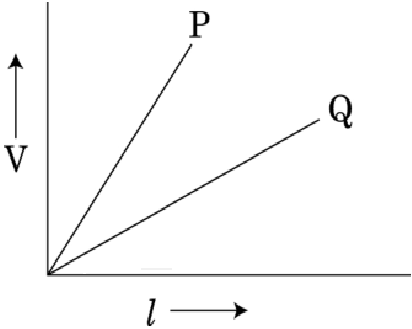
The variation of potential V with length l in case of two potentiometers wires P and Q is as shown. Which one of these will you prefer comparing emfs of two primary cells and why?

Mark the correct statements:
  1. Equations of special relativity are not applicable for small speeds.
  2. Equations of special relativity are applicable for all speeds.
  3. Nonrelativistic equations give exact result for small speeds.
  4. Nonrelativistic equations never give exact result.
The sun is less bright at morning and evening as compared to at noon although its distance from the observer is almost the same. Why?
A stone is fastened to one end of a string and is whirled in a vertical circle of radius R. Find the minimum speed the stone can have at the highest point of the circle.
Can we have a single north pole? A single south pole?
Show on a graph, the variation of resistivity with temperature for a typical semiconductor.