MCQ
If $\vec{P} \cdot \vec{Q} \quad P Q$, then angle between $\vec{P}$ and $\vec{Q}$ is
  • $0^{\circ}$
  • B
    $30^{\circ}$
  • C
    $45^{\circ}$
  • D
    $60^{\circ}$

Answer

Correct option: A.
$0^{\circ}$
(a) $\cos \theta=\frac{\vec{P} \cdot \vec{Q}}{ PQ }=1 \therefore \theta=0^{\circ}$

Need a full question paper?

Generate a complete, print-ready paper with questions like this in minutes — across 16+ boards, with answer keys.
Start Generating Free

Similar questions

There is a horizontal film of soap solution. On it a thread is placed in the form of a loop. The film is pierced inside the loop and the thread becomes a circular loop of radius $R$. If the surface tension of the loop be $T$, then what will be the tension in the thread
Liquid is filled in a vessel which is kept in a room with temperature $20^{\circ} \mathrm{C}$. When the temperature of the liquid is $80^{\circ} \mathrm{C}$, then it loses heat at the rate of $60 \mathrm{cal} / \mathrm{sec}$. What will be the rate of loss of heat when the temperature of the liquid is $40^{\circ} \mathrm{C}$
Water falls from a tap, down the streamline
If the temperature of a hot body is increased by $50 \%$ then the increase in the quantity of emitted heat radiation will be
The adiabatic elasticity of hydrogen gas $(\gamma=1.4)$ at NTP is
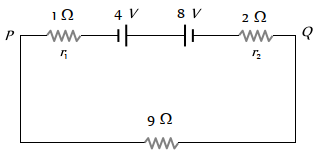
Two batteries of e.m.f. $4 V$ and $8 V$ with internal resistances $1 \Omega$ and $2 \Omega$ are connected in a circuit with a resistance of $9 \Omega$ as shown in figure. The current and potential difference between the points $P$ and $Q$ are

Image

Two coherent monochromatic light beams of intensities $I$ and $4 l$ are superposed. The maximum and minimum possible intensities in the resulting beam are
A luminous object is placed at a distance of $30 \mathrm{~cm}$ from the convex lens of focal length $20 \mathrm{~cm}$. On the other side of the lens, at what distance from the lens a convex mirror of radius of curvature $10 \mathrm{~cm}$ be placed in order to have an upright image of the object coincident with it
In a step up transformer, if ratio of turns of primary to secondary is $1: 10$ and primary voltage is $230 \mathrm{~V}$. If the load current is $2 A$, then the current in primary is
For an ideal gas, in an isothermal process