MCQ
If wavelength of a wave is $\lambda = 6000Å.$ Then wave number will be
  • A
    $166 \times {10^3}m^{-1}$ 
  • B
    $16.6 \times {10^{ - 1}}m^{-1}$ 
  • $1.66 \times {10^6}m^{-1}$ 
  • D
    $1.66 \times {10^7}m^{-1}$ 

Answer

Correct option: C.
$1.66 \times {10^6}m^{-1}$ 
c
(c) $\bar n = \frac{1}{\lambda } = \frac{1}{{6000 \times {{10}^{ - 10}}}}$

$ = 1.66 \times {10^6}{m^{ - 1}}$

Need a full question paper?

Generate a complete, print-ready paper with questions like this in minutes — across 16+ boards, with answer keys.
Start Generating Free

Similar questions

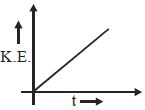
The kinetic energy of a body moving along a straight line varies with time as shown in figure. The force acting on body
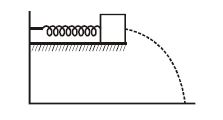
As shown in figure there is a spring block system. Block of mass $500\,g$ is pressed against a horizontal spring fixed at one end to compress the spring through $5.0\,cm$ . The spring constant is $500\,N/m$ . When released, calculate the distance where it will hit the ground $4\,m$ below the spring ? $(g = 10\,m/s^2)$
The mass of moon is $1\%$ of mass of earth. The ratio of gravitational pull of earth on moon and that of moon on earth will be
Two long capillary tubes $A$ and $B $ of radius $R_B>R_A$ dipped in same liquid. Then
A thin wire of length $/$ and mass $m$ is bent in the form of a semicircle. The moment of inertia about an axis perpendicular to its plane and passing through the end of the wire is .............
The vernier scale used for measurement has a positive zero error of $0.2\, mm$. If while taking a measurement it was noted that $'0'$ on the vernier scale lies between $8.5\, cm$ and $8.6\, cm$ vernier coincidence is $6,$ then the correct value of measurement is ............. $cm$. (least count $=0.01\, cm )$
Two stars of masses $m$ and $2\, m$ at a distance $d$ rotate about their common centre of mass in free space. The period of revolution is
Two masses $m_1$ and $m_2$ are connected by a massless spring of spring constant $k$ and unstretched length $l$. The masses are placed on a frictionless straight channel, which we consider our $X$-axis. They are initially at rest at $x=0$ and $x=l$, respectively. At $t=0$, a velocity of $v_0$ is suddenly imparted to the first particle. At a later time $t$, the centre of mass of the two masses is at
Two point masses having mass $M$ and $4 M$ are placed at distance $r$. The gravitational potential at a point, where gravitational field intensity zero is ..............
Which of the following quantities are always positive in a simple harmonic motion?

  1. $\overrightarrow{\text{F}}.\overrightarrow{\text{a}}$

  2. $\overrightarrow{\text{v}}.\overrightarrow{\text{r}}$

  3. $\overrightarrow{\text{a}}.\overrightarrow{\text{r}}$

  4. $\overrightarrow{\text{F}}.\overrightarrow{\text{r}}$