MCQ
If $x \propto {t^{5/2}}$ , then
  • A
    $v \propto {t^{3/2}}$
  • B
    $a \propto \sqrt t $
  • both$ (A)$ and $(B)$
  • D
    $v \propto \sqrt t $

Answer

Correct option: C.
both$ (A)$ and $(B)$
c
Given $x \propto t^2 \quad \Rightarrow x= Kt ^2 \quad$ where $K = constant$

$\therefore$ Velocity of the particle $v =\frac{ dx }{ dt }=2 Kt$

$\therefore$ Acceleration of the particle $a =\frac{ dv }{ dt }=2 K = constant$

Need a full question paper?

Generate a complete, print-ready paper with questions like this in minutes — across 16+ boards, with answer keys.
Start Generating Free

Similar questions

One mole of a monoatomic ideal gas is expanded by a process described by $p V^3=C$, where $C$ is a constant. The heat capacity of the gas during the process is given by ( $R$ is the gas constant)
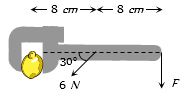
When a force of $6.0 \,N $ is exerted at ${30^o}$ to a wrench at a distance of $8 \,cm $ from the nut, it is just able to loosen the nut. What force $F$ would be sufficient to loosen it, if it acts perpendicularly to the wrench at $16\, cm$ from the nut ....... $N$
A stone thrown upward with a speed $u$ from the top of a tower reaches the ground with a velocity $4 u$. The height of the tower is .........
$A$ particle moving with kinetic energy $= 3$ joule makes an elastic head on collision with a stationary particle which has twice its mass during the impact.
The two gases with the ratio 3 : 2 of their masses in a container are at a temperature T. The ratio of the kinetic energies of the molecule of two gases is:
Every planet revolves around the sun in an elliptical orbit :

$A.$ The force acting on a planet is inversely proportional to square of distance from sun.

$B.$ Force acting on planet is inversely proportional to product of the masses of the planet and the sun

$C.$ The centripetal force acting on the planet is directed away from the sun.

$D.$ The square of time period of revolution of planet around sun is directly proportional to cube of semi-major axis of elliptical orbit.

Choose the correct answer from the options given below :
A sphere of mass m, moving with a speed v, strikes a wall elastically at an angle of incidence I. If the speed of the sphere before and after collision is the same and the angle of incidence and velocity normally towards the wall the angle of rebound is equal to the angle of incidence and velocity normally towards the wall is taken as negative then, the change in the momentum parallel to wall is:
A stone is projected from ground at $t = 0$. At the time of projection horizontal and vertical component of velocity are $10\, m/s$ and $20\, m/s$ respectively. Then time at which tangential and normal acceleration magnitude will be equal $(g = 10\, m/s^2)$ [neglect air friction]    ......... $\sec$
The area of the triangle formed by $2\hat i + \hat j - \hat k$ and $\hat i + \hat j + \hat k$ is
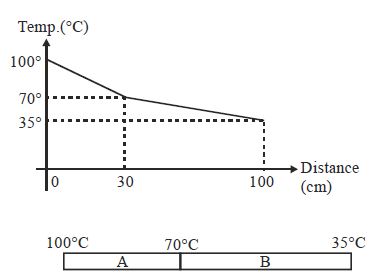
Two different rods $A$ and $B$ are kept as shown in figure. The variation of temperature of different cross sections is plotted in a graph shown in figure. The ratio of thermal conductivities of $A$ and $B$ is