Question
If $x : y = 6 : 11$, find $(8x - 3y) : (3x + 2y).$

Answer

$\text{x : y}=6:11$
$\frac{\text{x}}{\text{y}}=\frac{6}{11}$ Now $(8\text{x} - 3\text{y}) : (3\text{x} + 2\text{y})$
$=\frac{8\text{x}-3\text{y}}{3\text{x}+2\text{y}}=\frac{8\frac{\text{x}}{\text{y}}-3\frac{\text{y}}{\text{y}}}{3\frac{\text{x}}{\text{y}}+2\frac{\text{y}}{\text{y}}}$ (Dividing each term by $y)$
$=\frac{8\frac{\text{x}}{\text{y}}-3}{3\frac{\text{x}}{\text{y}}+2}=\frac{8\times\frac{6}{11}-3}{3\times\frac{6}{11}+2}$
$\Big(\because\frac{\text{x}}{\text{y}}=\frac{6}{11}\Big)$
$=\frac{\frac{48}{11}+3}{\frac{18}{11}+2}=\frac{\frac{48-33}{11}}{\frac{18+22}{11}}$
$=\frac{\frac{15}{11}}{\frac{40}{11}}=\frac{15}{11}\times\frac{11}{40}=\frac{3}{8}$
$(8\text{x}-3\text{y}):(3\text{x}+2\text{y})=3:8$

Need a full question paper?

Generate a complete, print-ready paper with questions like this in minutes — across 16+ boards, with answer keys.

Start Generating Free

Similar questions

Draw a triangle $A B C$, with $A C=4 cm, B C=3 cm$ and $\angle C =80^{\circ}$. Measure $A B$.
Is $(A B)^2=(A C)^2+(B C)^2$ ? If not, which one of the following is true:
$(A B)^2>(A C)^2+(B C)^2$ or $(A B)^2<(A C)^2+(B C)^2 ?$
From a circular card sheet of radius 14 cm , two circles of radius 3.5 cm and a rectangle of length 3 cm and breadth 1 cm are removed. (as shown in the adjoining figure). Find the area of the remaining sheet. $\left(\right.$ take $\left.\pi=\frac{22}{7}\right)$
Image
Sudhanshu divides a circular disc of radius $7 \ cm$ in two equal parts. What is the perimeter of each semicircular shape disc? (Use $\pi = \frac{22}{7}$)
The side $B C$ of $\triangle A B C$ is produced to a point $D$. The bisector of $\angle A$ meets side $B C$ in $L$. If $\angle A B C=30^{\circ}$ and $\angle A C D=115^{\circ}$, find $\angle A L C$.
Construct a $\triangle\text{ABC}$ in which $BC = 4.8\ cm$,$\angle\text{C}=90^\circ.$and $AB = 6.3\ cm.$
$\text{x}-\frac{\text{x}}{4}-\frac{1}{2}=3+\frac{\text{x}}{4}$
A light year is the distance that light can travel in one year.
1 light year $=9460000000000 km$
(i) Express one light year in scientific notation.
(ii) The average distance between Earth and Sun is $1.496 \times 10^8 km$. Is the distance between Earth and the Sun greater than, less than or equal to one light-year?
Image
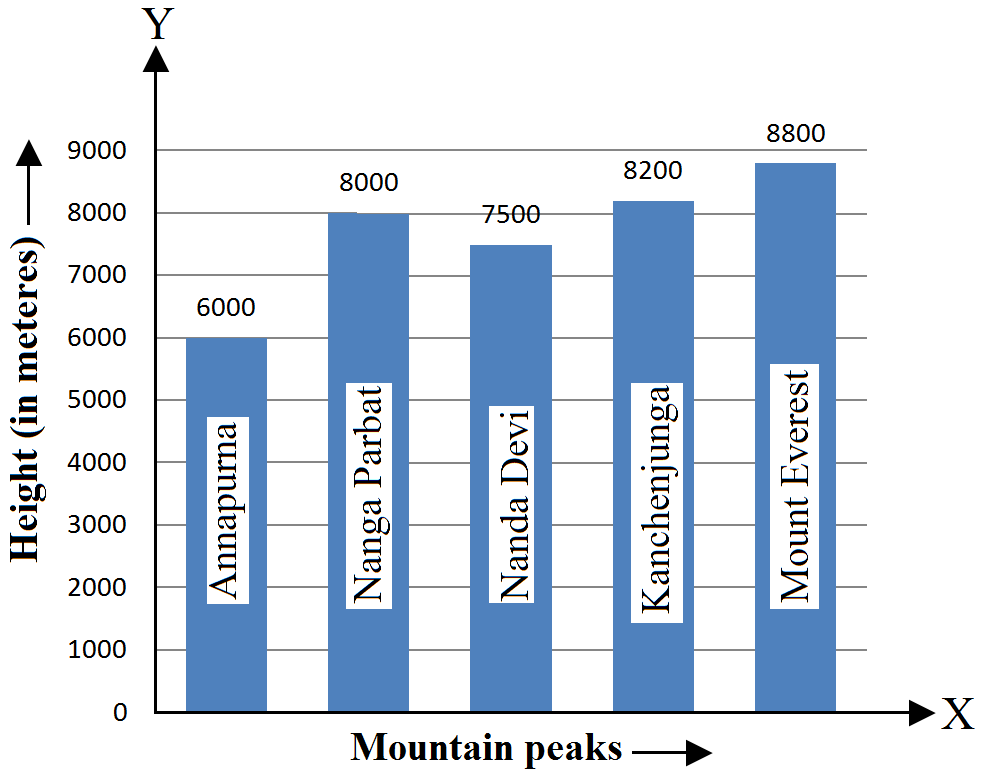
Given below is a bar graph showing the heights of five mountain peaks.

Read the bar graph carefully and answer the following questions:
$i.$ Which is the highest peak and what is its height?
$ii.$ What is the ratio of the heights of the highest peak and the next highest peak?
$iii.$ Arrange the heights of the given peaks in descending order.
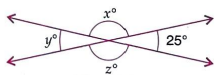
In Fig. find the values of x, y and z.
Image
Ravish and Ravi went for a picnic. Their grandmother gave them a water bottle that contained 5 litres of water. Ravish consumed $\frac{2}{5}$ of the water. Ravi consumed the remaining water.
(i) How much water did Ravish drink?
(ii) What fraction of the total quantity of water did Ravi drink?