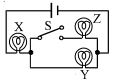
If $X, Y$ and $Z$ in figure are identical lamps, which of the following changes to the brightnesses of the lamps occur when switch $S$ is closed?
Easy


Download our appand get started for free
Experience the future of education. Simply download our apps or reach out to us for more information. Let's shape the future of learning together!No signup needed.*
Similar Questions
- 1View SolutionThe specific resistance of all metals is most affected by
- 2Three resistances of one ohm each are connected in parallel. Such connection is again connected with $\frac{2}{3}\,\Omega $ resistor in series. The resultant resistance will be ........... $\Omega$View Solution
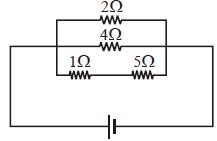
- 3A current of $3\,amp$ flows through the $2\,\Omega $ resistor shown in the circuit. The power dissipated in the $5\,\Omega $ resistor is ................. $watt$View Solution
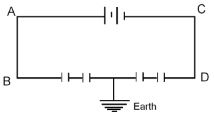
- 4Four equal capacitors are connected to a battery as shown in the adjoining figure. The potential of $A$ and $B$ areView Solution
- 5View SolutionA potential difference is applied across the ends of a metallic wire. If the potential difference is doubled, then the drift velocity
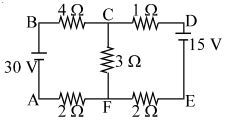
- 6The figure shows a network of five resistances and two batteries The current through the $15\,V$ battery is .............. $A$View Solution
- 7A current of $2\,A$ flows through a $2\,\Omega$ resistor when connected across a battery. The same battery supplies a current of $0.5\,\, A$ when connected across a $9 \,\,\Omega$ resistor. The internal resistance of the battery isView Solution
- 8$3$ identical bulbs are connected in series and these together dissipate a power $P$. If now the bulbs are connected in parallel, then the power dissipated will beView Solution
- 9The charge flowing in a conductor varies with time as $Q = at -bt^2$. Then for current, which statement is incorrect.View Solution
$(A)$ decreases linearly with time
$(B)$ reaches a maximum and then decreases
$(C)$ fall to zero after time $t = a/2b$
$(D)$ changes at a rate $-2b$
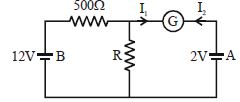
Options : - 10In the adjoining circuit, the galvanometer $G$ shows zero deflection. If the batteries $A$ and $B$ have negligible internal resistance, the value of the resistor $R$ will be .............. $\Omega$View Solution