Question
If $x^{16}y^9 = (x + y)^{17}, $ prove that $\text{x}\frac{\text{dy}}{\text{dx}}=2\text{y}$

Answer

Here,$x^{16}y^9 = (x + y)^{20}$​​​​​​​
Taking log on both the siede,
$\log(\text{x}^{16}\times\text{y}^{19})=\log(\text{x}^2+\text{y})^{17}$
$\big[\text{since}, \log(\text{AB})=\log\text{A}+\log\text{B},\log\text{a}^\text{b}=\text{b}\log\text{a}\big]$
$16\log\text{x}+9\log\text{y}=17\log(\text{x}^2+\text{y})$
Differentiating it with respect to x using chain rule
$16\frac{\text{d}}{\text{dx}}(\log\text{x})+9\frac{\text{d}}{\text{dx}}(\log\text{y})=17\frac{\text{d}}{\text{dx}}\log(\text{x}^2+\text{y})$
$\frac{16}{\text{x}}+\frac{9}{\text{y}}\frac{\text{dy}}{\text{dx}}=17\frac{1}{(\text{x}^2+\text{y})}\frac{\text{d}}{\text{dx}}(\text{x}^2+\text{y})$
$\frac{16}{\text{x}}+\frac{9}{\text{y}}\frac{\text{dy}}{\text{dx}}=\frac{17}{\text{x}^2+\text{y}}\Big[2\text{x}+\frac{\text{dy}}{\text{dx}}\Big]$
$\frac{9}{\text{y}}\frac{\text{dy}}{\text{dx}}-\frac{17}{(\text{x}^2+\text{y})}\frac{\text{dy}}{\text{dx}}=\Big(\frac{34\text{x}}{\text{x}^2+\text{y}}\Big)-\frac{16}{\text{x}}$
$\frac{\text{dy}}{\text{dx}}\Big[\frac{9}{\text{y}}-\frac{17}{(\text{x}^2+\text{y})}\Big]=\frac{34\text{x}^2-16\text{x}^2-16\text{y}}{\text{x}(\text{x}^2+\text{y})}$
$\frac{\text{dy}}{\text{dx}}\Big[\frac{9\text{x}^2+9\text{y}-17\text{y}}{\text{y}(\text{x}^2+\text{y})}\Big]=\frac{18\text{x}^2-16\text{y}}{\text{x}(\text{x}^2+\text{y})}$
$\frac{\text{dy}}{\text{dx}}=\frac{\text{y}}{\text{x}}\Big(\frac{2(9\text{x}^2-8\text{y})}{9\text{x}^2-8\text{y}}\Big)$
$\frac{\text{dy}}{\text{dx}}=\frac{2\text{y}}{\text{x}}$
$\text{x}\frac{\text{dy}}{\text{dx}}=2\text{y}$

Need a full question paper?

Generate a complete, print-ready paper with questions like this in minutes — across 16+ boards, with answer keys.
Start Generating Free

Similar questions

If $\text{y}=\big\{\log_{\cos\text{x}}\sin\text{x}\big\}\big\{\log_{\sin\text{x}}\cos\text{x}\big\}^{-1}+\sin^{-1}\Big(\frac{2\text{x}}{1+\text{x}^2}\Big),$ find $\frac{\text{dy}}{\text{dx}}$ at $\text{x}=\frac{\pi}{4}$
Show that the following system of linear equation is inconsistent:
$2x + 5y = 7$
$6x + 15y = 13$
If $\text{A}=\begin{bmatrix}-2\\4\\5\end{bmatrix},\text{B}=\begin{bmatrix}1&3&-6\end{bmatrix},$ verify that $(AB)^T = B^TA^T$​​​​​​​
Solve the following differential equation:$4\frac{\text{dy}}{\text{dx}}+8\text{y}=5\text{e}^{-3\text{x}}$
Solve the following differential equation
$(\sin\text{x}+\cos\text{x})\text{dy}+(\cos\text{x}+\sin\text{x})\text{dx}=0$
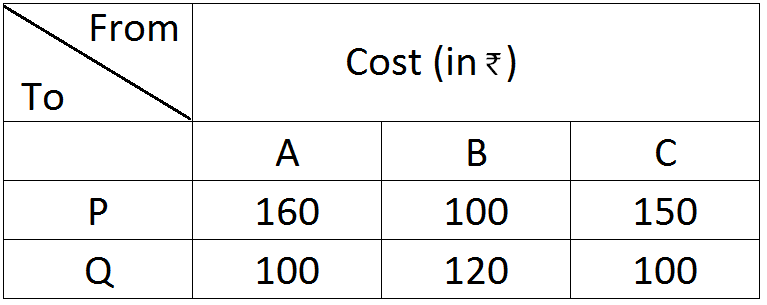
There are two factories located one at place P and the other at place Q. From these locations, a certain commodity is to be delivered to each of the three depots situated at A, B and C. The weekly requirements of the depots are respectively 5, 5 and 4 units of the commodity while the production capacity of the factories at P and Q are respectively 8 and 6 units. The cost of transportation per unit is given below:
How many units should be transported from each factory to each depot in order that the transportation cost is minimum. What will be the minimum transportation cost?
Maximize Z = 5x + 3y
Subject to
$3\text{x}+5\text{y}\leq15$
$5\text{x}+2\text{y}\leq10$
$\text{x},\text{y}\geq0$
If $\text{y}=\text{x}^3\log\text{x},$ Prove that $\frac{\text{d}^4\text{y}}{\text{dx}^4}=\frac{6}{\text{x}}$
Find the distance of the point (1, -2, 4) from plane passing throuhg the point (1, 2, 2) and perpendicular of the planes x - y + 2z = 3 and 2x - 2y + z + 12 = 0
If $\vec{\text{a}},\ \vec{\text{b}},\ \vec{\text{c}}$ are non-coplanar vectors, prove that the point having the following position vectors is collinear:$\vec{\text{a}}+\vec{\text{b}}+\vec{\text{c}},\ 4\vec{\text{a}}+3\vec{\text{b}},\ 10\vec{\text{a}}+7\vec{\text{b}}-2\vec{\text{c}}$