MCQ
If $\text{x}=\text{a}\cos\ \text{nt}-\text{b}\sin\ \text{nt}$ then $\frac{\text{d}^2\text{x}}{\text{dt}^2}$ is:
  • A
    $n^2x$
  • $-n^2x$
  • C
    $-nx$
  • D
    $nx$

Answer

Correct option: B.
$-n^2x$

Here
$\text{x}=\text{a}\cos\text{nt}-\text{b}\sin\text{nt}$
Differentiating w.r.t.t, we get
$\frac{\text{dx}}{\text{dt}}=-\text{an}\sin\text{nt}-\text{bn}\cos\text{nt}$
Differentiating w.r.t.t, we get
$\frac{\text{d}^2\text{x}}{\text{dt}^2}=-\text{an}^2\cos\text{nt}+\text{bn}^2\sin\text{nt}$
$=-\text{n}^2\text{a}\cos\text{nt}-\text{b}\sin\text{nt}$
$=-\text{n}^2\text{x}$

Need a full question paper?

Generate a complete, print-ready paper with questions like this in minutes — across 16+ boards, with answer keys.
Start Generating Free

Similar questions

A letter is known to have come either from $\text{LONDON}$ or $\text{CLIFTON}$; on the postmark only the two consecutive letters $\text{ON}$ are ellegible. The probability that it came from $\text{LONDON}$ is:
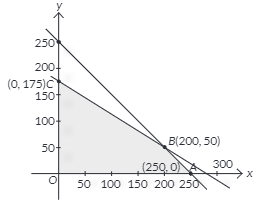
The corner points of the bounded feasible region of an LPP are $O(0,0), A(250,0), B(200,50)$ and $C(0,175)$. If the maximum value of the objective function $Z=2 a x+$ by occurs at the points $A(250,0)$ and $B(200,50)$, then the relation between $a$ and $b$ is:
Image
The points (k − 1, k + 2), (k, k + 1), (k + 1, k) are collinear for:
  1. any value of k
  2. k = −21​ only
  3. no value of k
  4. integral values of k only
If $\int\frac{1}{(\text{x}+2)(\text{x}^2+1)}\text{ dx}=\text{a}\log|1+\text{x}^2|+\text{b}\tan^{-1}\text{x}+\frac{1}{5}\log|\text{x}+2|+\text{C},$ then
  1. $\text{a}=-\frac{1}{10},\text{ b}=\frac{2}{5}$
  2. $\text{a}=\frac{1}{10},\text{ b}=\frac{2}{5}$
  3. $\text{a}=-\frac{1}{10},\text{ b}=\frac{2}{5}$
  4. $\text{a}=\frac{1}{10},\text{ b}=\frac{2}{5}$
Let $X_1$ and $X_2$ are optimal solutions of a $LPP,$ then:
Let $R$ be a relation in the set $N$ given by $R=\{(a, b): a=b-2, b>6\}$. Then
The general solution of the differential equation $x\left(1-y^2\right) d x+y\left(1-x^2\right) d y=0$ is
The corner points of the feasible region determined by the system of linear inequalities are $(0,0),(4,0),(2,4)$ and $(0,5)$. If the maximum value of $Z=a x+b y$, where $a, b>0$ occurs at both $(2,4)$ and $(4,0)$, then
$\int \frac{\sin x}{(1+\sin x)} d x=?$
The area bounded by the parabola $x = 4 - y^2$ and $y-$axis, in square units, is: