Question
If $\text{x}=\Big(\text{t}+\frac{1}{\text{t}}\Big)^\text{a},\text{y}=\text{a}^{\text{t}+\frac{1}{\text{t}}},$ find $\frac{\text{dy}}{\text{dx}}$

Answer

Here, $\text{x}=\Big(\text{t}+\frac{1}{\text{t}}\Big)^{\text{a}}$
Differentiating it with respect to t using chain rule,
$\frac{\text{dx}}{\text{dt}}=\frac{\text{d}}{\text{dt}}\left[\Big(\text{t}+\frac{1}{\text{t}}\Big)^{\text{a}}\right]$
$=\text{a}\Big(\text{t}+\frac{1}{\text{t}}\Big)^{\text{a-1}}\frac{\text{d}}{\text{dt}}\Big(\text{t}+\frac{1}{\text{t}}\Big)$
$\frac{\text{dx}}{\text{dt}}=\text{a}\Big(\text{t}+\frac{1}{\text{t}}\Big)^{\text{a-1}}\Big(\text{1}-\frac{1}{\text{t}^{2}}\Big)\ .....(\text{i})$
And, $\text{y}=\text{a}^{(\text{t}+\frac{1}{\text{t}})}$
Differentiating it with respect to t using chain rule,
$\frac{\text{dy}}{\text{dt}}=\frac{\text{d}}{\text{dt}}\bigg[\text{a}^{\big(\text{t}+\frac{1}{\text{t}}\big)}\bigg]$
$=\frac{\text{d}}{\text{dt}}\text{a}^{\big(\text{t}+\frac{1}{\text{t}}\big)}\times\log\frac{\text{d}}{\text{dt}}\left(\text{t}+\frac{1}{\text{t}}\right)$
$\frac{\text{dy}}{\text{dt}}=\text{a}^{\big(\text{t}+\frac{1}{\text{t}}\big)}\times\log\text{a}\Big(\text{t}-\frac{1}{\text{t}^{2}}\Big)\ .....(\text{ii})$
Dividing equation (ii) by (i),
$\frac{\frac{\text{dy}}{\text{dt}}}{\frac{\text{dx}}{\text{dt}}}=\frac{\text{a}^{\big(\text{t}+\frac{1}{\text{t}}\big)}\times\log\text{a}\left(1-\frac{1}{\text{t}^{2}}\right)}{\text{a}\big(\text{t}+\frac{1}{\text{t}}\big)^{\text{a}-1}\big(1-\frac{1}{\text{t}}^{2}\big)}$
$\frac{\text{dy}}{\text{dx}}=\frac{\text{a}^{\big(\text{t}+\frac{1}{\text{t}}\big)}\times\log\text{a}}{\text{a}\big(\text{t}+\frac{1}{\text{t}}\big)^{\text{a}-1}}$

Need a full question paper?

Generate a complete, print-ready paper with questions like this in minutes — across 16+ boards, with answer keys.
Start Generating Free

Similar questions

Evaluate the following integrals as limit of sum:
$\int\limits^{3}_{2}\text{x}^2\text{ dx}$
Find the area of the region bounded by the paraola $y^2 = 4ax$ and line $x = a.$
Evaluate the following intregals:
$\int\frac{\text{x}^2+\text{x}+1}{\text{x}^2-1}\text{ dx}\int\frac{\text{x}^2+\text{x}+1}{\text{x}^2-1}\ \text{dx}$
Let f: N $\rightarrow$ N be defined by
$ \text{f(n)} = \begin{cases} \frac{\text{n + 1}}{2}, & \text{if n is odd}\\ \frac{\text{n}}{2},& \text{if n is even}\\ \end{cases}$for all n $\in$ N.
Find whether the function f is bijective.
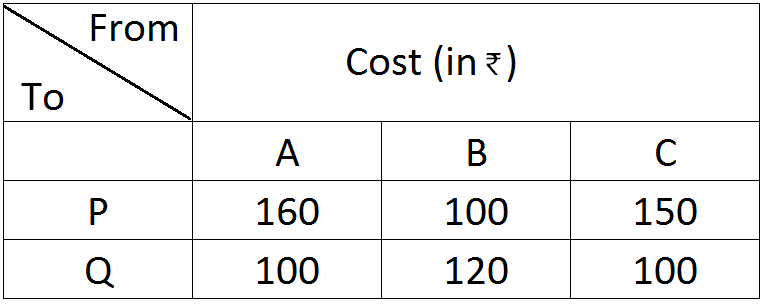
There are two factories located one at place P and the other at place Q. From these locations, a certain commodity is to be delivered to each of the three depots situated at A, B and C. The weekly requirements of the depots are respectively 5, 5 and 4 units of the commodity while the production capacity of the factories at P and Q are respectively 8 and 6 units. The cost of transportation per unit is given below:
How many units should be transported from each factory to each depot in order that the transportation cost is minimum. What will be the minimum transportation cost?
Prove that $ \tan^{-1}\bigg[\frac{\sqrt{1 + \text{x}} - \sqrt{1 - \text{x}}}{\sqrt{1 + \text{x}} + \sqrt{1 - \text{x}}}\bigg] = \frac{\pi}{4} - \frac{1}{2}\cos^{-1}\text{x} , \frac{1}{\sqrt{2}}\leq\text{x}\leq1$
Show that the minimum of Z occurs at more than two points.
Minimize and Maximize Z = 5x + 10y subject to $x + 2y \leq 120, \ x + y \geq 60$, $x - 2y \geq 0, \ x, \ y \geq 0$.
Evaluate:
$\int\limits^{\pi/4}_{0}\bigg(\frac{\sin \text{x} +\cos \text{x}}{3 + \sin 2\text{x}}\bigg)\text{dx}$
Find the coordinates of the point where the line $\frac{\text{x}-2}{3}=\frac{\text{y}+1}{4}=\frac{\text{z}-2}{2}$ intersect the plane x - y + z - 5 = 0. Also, find the angle between the line and the plane.
In each of the show that the given differential equation is homogeneous and solve each of them.
$(\text{x}^2+\text{xy})\ \text{dy}=({\text{x}^{2}+\text{y}^{2}})\ \text{dx}$