MCQ
If ${x^p}{y^q} = {(x + y)^{p + q}},$ then ${{dy} \over {dx}} = $
  • ${y \over x}$
  • B
    $ - {y \over x}$
  • C
    ${x \over y}$
  • D
    $ - {x \over y}$

Answer

Correct option: A.
${y \over x}$
a
(a) Taking $\log $ both sides,

$p\log x + q\log y = (p + q)\log (x + y)$

==> $\frac{p}{x} + \frac{q}{y}\frac{{dy}}{{dx}} = \frac{{p + q}}{{x + y}}\left( {1 + \frac{{dy}}{{dx}}} \right) $

$\Rightarrow \frac{{dy}}{{dx}} = \frac{y}{x}$.

Need a full question paper?

Generate a complete, print-ready paper with questions like this in minutes — across 16+ boards, with answer keys.
Start Generating Free

Similar questions

A dice is thrown ten times. If getting even number is considered as a success, then the probability of four successes is
The area bounded by the y-axis, $\text{y}=\cos\text{x}$ and $\text{y}=\sin\text{x}$ when $0\leq\text{x}\leq\frac{\pi}{2}$ is:
  1. $2\big(\sqrt{2}-1\big)$
  2. $\sqrt{2}-1$
  3. $\sqrt{2}+1$
  4. $\sqrt{2}$ 
Vector coplanar with vectors $i + j $ and $ j + k$  and parallel to the vector $2i -2j -4k$ , is
$\int_a^b {\frac{{\log x}}{x}\,dx = } $
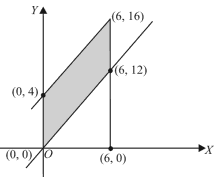
The feasible region for an LPP is shown shaded in the figure. Let $F=3 x-4 y$ be the objective function.
Maximum value of $F$ is
Image
A line $l$ passing through the origin is perpendicular to the lines

$l_1:(3+ t ) \hat{ i }+(-1+2 t ) \hat{ j }+(4+2 t ) \hat{ k },-\infty< t <\infty $

$l_2:(3+2 t ) \hat{ i }+(3+2 t ) \hat{ j }+(2+ s ) \hat{ k },-\infty< s <\infty$

Then, the coordinate$(s)$ of the point$(s)$ on $l_2$ at a distance of $\sqrt{17}$ from the point of intersection of $l$ and $l_1$ is(are)

$(A)$ $\left(\frac{7}{3}, \frac{7}{3}, \frac{5}{3}\right)$ $(B)$ $(-1,,-1,0)$ $(C)$ $(1,1,1)$ $(D)$ $\left(\frac{7}{9}, \frac{7}{9}, \frac{8}{9}\right)$

$\cos[\tan^{-1}\{\sin(\cot^{-1}\text{x})\}]$ is equal to:
  1. $\sqrt{\frac{\text{x}^2+2}{\text{x}^3+3}}$
  2. $\sqrt{\frac{\text{x}^2+2}{\text{x}^2+1}}$
  3. $\sqrt{\frac{\text{x}^2+1}{\text{x}^2+2}}$
  4. None of these.
$\mathop \smallint \limits_3^6 \frac{{\sqrt x }}{{\sqrt {9 - x} + \sqrt x }}\;dx = $
If $f(x) = \frac{x}{{x - 1}} = \frac{1}{y}$, then $f(y) = $
Let $P=\left[\begin{array}{ccc}3 & -1 & -2 \\ 2 & 0 & \alpha \\ 3 & -5 & 0\end{array}\right]$, where $\alpha \in \mathbb{R}$. Suppose $Q=\left[q_{i j}\right]$ is a matrix such that $P Q=k I$, where $k \in \mathbb{R}, k \neq 0$ and $I$ is the identity matrix of order $3$ . If $q_{23}=-\frac{k}{8}$ and $\operatorname{det}(Q)=\frac{k^2}{2}$, then

($A$) $\quad \alpha=0, k=8$

($B$) $4 \alpha-k+8=0$

($C$) $\operatorname{det}(P \operatorname{adj}(Q))=2^9$

($D$) $\operatorname{det}(Q \operatorname{adj}(P))=2^{13}$