MCQ
If $y = {e^{{{\tan }^{ - 1}}x}}$, then $(1 + {x^2}){{{d^2}y} \over {d{x^2}}} = $
  • $(1 - 2x){{dy} \over {dx}}$
  • B
    $ - 2x{{dy} \over {dx}}$
  • C
    $ - x{{dy} \over {dx}}$
  • D
    $0$

Answer

Correct option: A.
$(1 - 2x){{dy} \over {dx}}$
a
(a) $y = {e^{{{\tan }^{ - 1}}x}} \Rightarrow \frac{{dy}}{{dx}} = \frac{{{e^{{{\tan }^{ - 1}}x}}}}{{1 + {x^2}}}$

$ \Rightarrow \frac{{{d^2}y}}{{d{x^2}}} = \frac{{(1 + {x^2}).\frac{{{e^{{{\tan }^{ - 1}}x}}}}{{(1 + {x^2})}} - {e^{{{\tan }^{ - 1}}x}}(2x)}}{{{{(1 + {x^2})}^2}}}$

$ \Rightarrow \frac{{{d^2}y}}{{d{x^2}}} = \frac{{(1 - 2x){e^{{{\tan }^{ - 1}}x}}}}{{{{(1 + {x^2})}^2}}}$

$ \Rightarrow \frac{{{d^2}y}}{{d{x^2}}}(1 + {x^2}) = (1 - 2x)\frac{{dy}}{{dx}}$.

Need a full question paper?

Generate a complete, print-ready paper with questions like this in minutes — across 16+ boards, with answer keys.
Start Generating Free

Similar questions

For a given matrix $A =$ $\left[ {\,\begin{array}{*{20}{c}}{\cos \theta }&{ - \,\sin \theta }\\{\sin \theta }&{\cos \theta }\end{array}\,} \right]$ which of the following statement holds good?
Let $T$ be the tangent to the ellipse $E: x^{2}+4 y^{2}=5$ at the point $P(1,1)$. If the area of the region bounded by the tangent $T$, ellipse $E$, lines $x=1$ and $x=\sqrt{5}$ is $\alpha \sqrt{5}+\beta+\gamma \cos ^{-1}\left(\frac{1}{\sqrt{5}}\right)$, then $|\alpha+\beta+\gamma|$ is equal to $....$
The order of the single matrix obtained from
$
\left[\begin{array}{rr}
1 & -1 \\
0 & 2 \\
2 & 3
\end{array}\right]\left\{\left[\begin{array}{rrr}
-1 & 0 & 2 \\
2 & 0 & 1
\end{array}\right]-\left[\begin{array}{lll}
0 & 1 & 23 \\
1 & 0 & 21
\end{array}\right]\right\} \text { is }
$
$\int\limits_{ - 4}^4 {\left( {{2^x} + {2^{ - x}}} \right)\left( {{3^x} + {3^{ - x}}} \right)} \,dx$ is equal to
If a relation R is defined on the set Z of integers as follows: (a, b) ∈ R ⇔ a2 + b2 = 25. Then, domain (R) is:
  1. {3, 4, 5}
  2. {0, 3, 4, 5}
  3. $\{0,\pm3,\pm4,\pm5\}$
  4. None of these.
$\left| {\,\begin{array}{*{20}{c}}{{{\log }_3}512}&{{{\log }_4}3}\\{{{\log }_3}8}&{{{\log }_4}9}\end{array}\,} \right| \times \left| {\,\begin{array}{*{20}{c}}{{{\log }_2}3}&{{{\log }_8}3}\\{{{\log }_3}4}&{{{\log }_3}4}\end{array}\,} \right|=$
If $\mathrm{x}=2 \sin \theta-\sin 2 \theta$ and $\mathrm{y}=2 \cos \theta-\cos 2 \theta$ ; $\theta \in[0,2 \pi],$ then $\frac{\mathrm{d}^{2} \mathrm{y}}{\mathrm{dx}^{2}}$ at $\theta=\pi$ is :
If the equation of a line $A B$ is $\frac{x-3}{1}=\frac{y+2}{-2}$ $=\frac{z-5}{4}$, find the direction ratios of a line parallel to $A B$.
Let $[ x ]$ denote the greatest integer function and $f ( x )=\max \{1+ x +[ x ], 2+ x , x +2[ x ]\}, 0 \leq x \leq 2$. Let $m$ be the number of points in $[0,2]$, where $f$ is not continuous and $n$ be the number of points in $(0,2)$, where $f$ is not differentiable. Then $(m+n)^2+2$ is equal to:
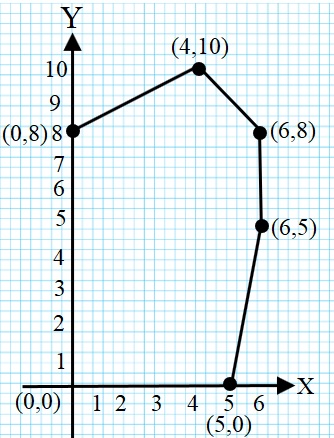
The feasible region for an LPP is shown below:

Let Z = 3x - 4y be the objective function. Minimum of Z occurs at