MCQ
If $\text{y}=\text{ax}^{\text{n+1}}+\text{bx}^{-\text{n}}$ Then $\text{x}^2\frac{\text{d}^2\text{y}}{\text{dx}^2} =$
  • A
    $n(n - 1) y$
  • $n(n + 1) y$
  • C
    $ny$
  • D
    $n^2y$

Answer

Correct option: B.
$n(n + 1) y$
Here
$\text{y}=\text{ax}^{\text{n}+1}+\text{bx}^{\text{-n}}$
$\Rightarrow\frac{\text{dy}}{\text{dx}}=\text{a}(\text{n}+1)\text{x}^\text{n}-\text{bn}\text{x}^{-\text{n}-1}$
$\Rightarrow\frac{\text{d}^2\text{y}}{\text{dx}^2}=\text{an}(\text{n}+1)\text{x}^{\text{n}-1}+\text{bn}(\text{n}+1)\text{x}^{-\text{n}-2}$
$\therefore\text{x}^2\frac{\text{d}^2\text{y}}{\text{dx}^2}=\text{x}^2\{\text{an}(\text{n}+1)\text{x}^{\text{n}-1}+\text{bn}(\text{n}+1)\text{x}^{-\text{n}-2}\}$
$=\text{n}(\text{n}+1)(\text{ax}^{\text{n}+1}+\text{b x}^{-\text{n}})$
$=\text{n}(\text{n}+1)\text{y}$

Need a full question paper?

Generate a complete, print-ready paper with questions like this in minutes — across 16+ boards, with answer keys.
Start Generating Free

Similar questions

If $A=\left[a_{i j}\right]=\left[\begin{array}{cc}2 & -1 \\ -3 & 4 \\ 1 & 2\end{array}\right]$ and $B=\left[b_{i j}\right]=\left[\begin{array}{ccc}2 & 3 & -5 \\ 1 & 4 & 9 \\ 0 & 7 & -2\end{array}\right]$, then value of $a_{11} b_{11}+a_{22} b_{22}$ is
If $\text{f}(\text{x})=(\cos\text{x}+\text{i}\sin\text{x})(\cos2\text{x}+\text{i}\sin2\text{x})(\cos3\text{x}+\text{i}\sin3\text{x})...(\cos\text{nx}+\text{i}\sin\text{nx})\ \text{and}\ \text{f}(1)=1, $ then f1 is equals to:
  1. $$$\frac{\text{n}(\text{n}+1)}{2}$
  2. $\Big\{\frac{\text{n}(\text{n}+1)}{2}\Big\}^2$
  3. $-\Big\{\frac{\text{n}(\text{n}+1)}{2}\Big\}^2$
  4. $\text{none of these}$
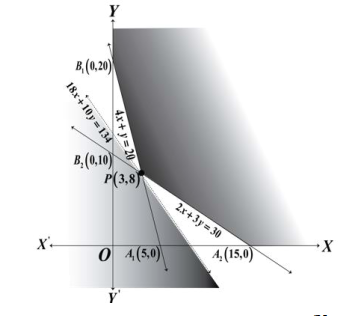
A linear programming problem (LPP) along eith the graph of its constraints is shown below.The correspondig objective function is :Z = 18x + 10y which has to be minimized. The smallest value of the objective function Z is 134 and is obtained at the corner point (3,8).
Image
The optimal solution of the above linear programming problem_______________.
If P(A) + P(B) = 1; then which of the following option explains the event A and B correctly?
  1. Event A and B are mutually exclusive, exhaustive and complementary events.
  2. Event A and B are mutually exclusive and exhaustive events.
  3. Event A and B are mutually exclusive and complementary events.
  4. Event A and B are exhaustive and complementary events.
The function $\text{f(x)}=|\cos\text{x}|$ is:
  1. Differentiable at$\text{x}=(2\text{n}+1)\frac{\pi}{2},\text{n}\in\text{Z}$
  2. Continuous but not differentiable at $\text{x}=(2\text{n}+1)\frac{\pi}{2},\text{n}\in\text{Z}$
  3. Neither differentiable nor continuous at $\text{x}=\text{n}\in\text{Z}$
  4. None of these.
Refer to Question 18 (Maximum value of Z+ Minimum value of Z) is equal to:
A Linear Programming Problem is as follows:
Minimize Z = 2x + y
Subject to the constraints $x \geq 3, x \leq 9, y \geq 0$
$x-y \geq 0, x+y \leq 14$
The feasible region has
Evaluate: $\int \sin ^3 x \cos ^3 x d x$
Choose the correct answer from the given four options.If two events are independent, then:
If the lines $\text{ x - }\frac{2}{1} =\text{y}-\frac{2}{1} =\text{z}-\frac{4}{\text{k}} $ and $\text{x}-\frac{1}{\text{k}} = \text{y}-\frac{4}{2} = \text{z}-\frac{5}{1} $ are coplanar, then k can have:
  1. Exactly two values
  2. Exactly three values
  3. Exactly one value
  4. Any value