MCQ
If you set up the seventh harmonic on a string fixed at both ends, how many nodes and antinodes are set up in it
  • $8, 7$
  • B
    $7, 7$
  • C
    $8, 9$
  • D
    $9, 8$

Answer

Correct option: A.
$8, 7$
a
(a) String will vibrate in $7$ loops so it will have $8$ nodes $7$ antinodes. 

Number of harmonics = Number of loops = Number of antinodes

$⇒$ Number of antinodes $= 7$

Hence number of nodes = Number of antinodes $+ 1 = 7 + 1 = 8$

Need a full question paper?

Generate a complete, print-ready paper with questions like this in minutes — across 16+ boards, with answer keys.

Start Generating Free

Similar questions

The electric field at the origin is along the positive x-axis. A small circle is drawn with the centre at the origin cutting the axes at points A, B, C and D having coordinates (a, 0), (0, a), (-a, 0), (0, -a) respectively. Out of the points on the periphery of the circle, the potential is minimum at.
  1. A
  2. B
  3. C
  4. D
When a car is approaching the observer, the frequency of horn is $100 Hz$. After passing the observer, it is $50\,Hz$. If the observer moves with the car, the frequency will be $\frac{ x }{3} Hz$ where $x =.....$
An automobile of mass $'m'$ accelerates starting from origin and initially at rest, while the engine supplies constant power $P$. The position is given as a function of time by:
Both earth and moon are subject to the gravitational force of the sun. As observed from the sun, the orbit of the moon.
  1. Will be elliptical.
  2. Will not be strictly elliptical because the total gravitational force on it is not central.
  3. Is not elliptical but will necessarily be a closed curve.
  4. Deviates considerably from being elliptical due to influence of planets other than earth.
Physical independence of force is a consequence of
A bubble has surface tension $S$. The ideal gas inside the bubble has ratio of specific heats $\gamma=\frac{5}{3}$. The bubble is exposed to the atmosphere and it always retains its spherical shape. When the atmospheric pressure is $P_{a 1}$, the radius of the bubble is found to be $r_1$ and the temperature of the enclosed gas is $T_1$. When the atmospheric pressure is $P_{a 2}$, the radius of the bubble and the temperature of the enclosed gas are $r_2$ and $T_2$, respectively.

Which of the following statement($s$) is(are) correct?

$(A)$ If the surface of the bubble is a perfect heat insulator, then $\left(\frac{r_1}{r_2}\right)^5=\frac{P_{a 2}+\frac{2 S}{r_2}}{P_{a 1}+\frac{2 S}{r_1}}$

$(B)$ If the surface of the bubble is a perfect heat insulator, then the total internal energy of the bubble including its surface energy does not change with the external atmospheric pressure.

$(C)$ If the surface of the bubble is a perfect heat conductor and the change in atmospheric temperature is negligible, then $\left(\frac{r_1}{r_2}\right)^3=\frac{P_{a 2}+\frac{4 S}{r_2}}{P_{a 1}+\frac{4 S}{r_1}}$.

$(D)$ If the surface of the bubble is a perfect heat insulator, then $\left(\frac{T_2}{T_1}\right)^{\frac{5}{2}}=\frac{P_{a 2}+\frac{4 S}{r_2}}{P_{a 1}+\frac{4 S}{r_1}}$.
The motion of a swing is:
Two sources $A$ and $B$ are sounding notes of frequency $660 \,Hz$. $A$ listener moves from $A$ to $B$ with a constant velocity $u$. If the speed of sound is $330 \,m / s$, what must be the value of $u$ so that he hears $8$ beats per second is .......... $m / s$
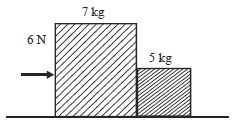
Two block of masses $7\, kg$ and $5\, kg$ are placed in contact with each other on a smooth surface. If a force of $6\, N$ is applied on the heavier mass, the force on the lighter mass is ............ $N$
The radius of the earth is $6400\, km$ and $g = 10\,m/{\sec ^2}$. In order that a body of $5 \,kg$ weighs zero at the equator, the angular speed of the earth is