Question
If $\text{y}=\text{x}\sin(\text{a}+\text{y}),$ prove that $\frac{\text{dy}}{\text{dx}}=\frac{\sin^2(\text{a}+\text{y})}{\sin(\text{a}+\text{y})-\text{y}\cos(\text{a}+\text{y})}$

Answer

Here,
$\text{y}=\text{x}\sin(\text{a}+\text{y})$
Differentiating with respect to x using the chain rule and product rule,
$\frac{\text{dy}}{\text{dx}}=\text{x}\frac{\text{d}}{\text{dx}}\sin(\text{a}+\text{y})+\sin(\text{a}+\text{y})\frac{\text{dx}}{\text{dx}}$
$\frac{\text{dy}}{\text{dx}}=\text{x}\cos(\text{a}+\text{y})\frac{\text{dy}}{\text{dx}}+\sin(\text{a}+\text{y})$
$(1-\text{x}\cos(\text{a}+\text{y}))\frac{\text{dy}}{\text{dx}}=\sin(\text{a}+\text{y})$
$\frac{\text{dy}}{\text{dx}}=\frac{\sin(\text{a}+\text{y})}{(1-\text{x}\cos(\text{a}+\text{y}))}$
$\frac{\text{dy}}{\text{dx}}=\frac{\sin(\text{a}+\text{y})}{\Big(1-\frac{\text{y}}{\sin(\text{a}+\text{y})}\cos(\text{a}+\text{y})\Big)}\ \Big[\text{Since}\frac{\text{y}}{\sin(\text{a}+\text{y})}=\text{x}\Big]$
$\frac{\text{dy}}{\text{dx}}=\frac{\sin^2(\text{a}+\text{y})}{\sin(\text{a}+\text{y})-\text{y}\cos(\text{a}+\text{y})}$

Need a full question paper?

Generate a complete, print-ready paper with questions like this in minutes — across 16+ boards, with answer keys.
Start Generating Free

Similar questions

The function f(x) is befined as follows: $\text{f(x)}=\begin{cases}\text{x}^2+\text{ax}+\text{b},&0\leq\text{x}<2\\3\text{x}+2,&2\leq\text{x}\leq4\\2\text{ax}+5\text{b},&4<\text{x}\leq8\end{cases}$ if is continuous on [0, 8] find the value of a and b.
If $x = a \sin 2t (1 + \cos 2t)$ and $y = b \cos 2t (1 – \cos 2t)$, show that at $\text{t}=\frac{\pi}{4},\big(\frac{\text{dy}}{\text{dx}}\big)=\frac{\text{b}}{\text{a}}$
Prove that if a plane has the intercepts a, b, c and is at a distance of p units from the origin, then $\frac{1}{\text{a}^2}+\frac{1}{\text{b}^2}+\frac{1}{\text{c}^2}=\frac{1}{\text{p}^2}.$
Find the equations of the tangent and the normal to the following curves at the indicated points.
$y = x^4 - 6x^3 + 13x^2 - 10x + 5$ at $x = 1$
Find the shortest distance between the lines $\frac{\text{x}+1}{7}=\frac{\text{y}+1}{-6}=\frac{\text{z}+1}{0}$ and $\frac{\text{x}-3}{1}=\frac{\text{y}-5}{-2}=\frac{\text{z}-7}{1}.$
Prove the following identities:
$\begin{vmatrix}\text{a}+\text{x}&\text{y}&\text{z}\\\text{x}&\text{a}+\text{y}&\text{z}\\\text{x}&\text{y}&\text{a}+\text{z}\end{vmatrix}=\text{a}^2(\text{a}+\text{x}+\text{y}+\text{z})$
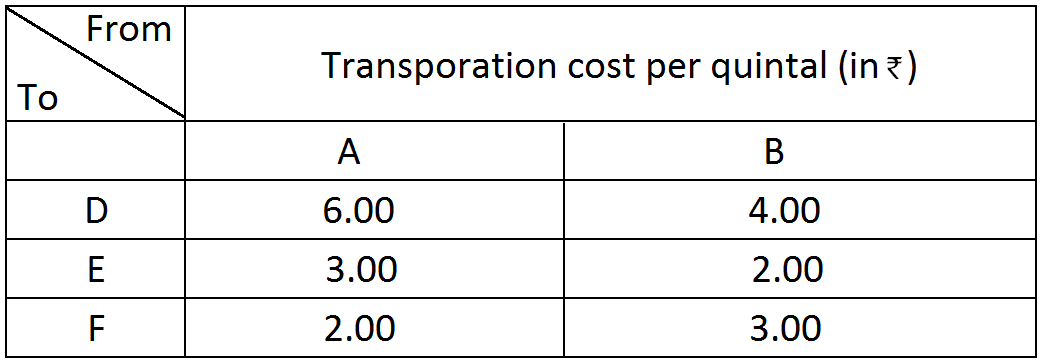
Tow godowns$, A$ and $B,$ have grain storage capacity of $100$ quintals and $50$ quintals respectively. They supply to $3$ ration shops$, D, E$ and $F,$ whose requirements are $60, 50$ and $40$ quintals respectively. The cost of transportation per quintal from the godowns to the shops are given in the following table:

How should the supplies be transported in order that the transportation cost is minimum? 
Write the minimum value of $\text{f}(\text{x})=\text{x}^\frac{1}{\text{x}}.$
Vitamins $A$ and $B$ are found in two different foods $F_1$ and $F_2.$ One unit of food $F_1$ contains $2$ units of vitamin $A$ and $3$ units of vitamin $B.$ One unit of food $F_2$ contains $4$ units of vitamin $A$ and $2$ units of vitamin $B.$ One unit of food $F_1$ and $F_2$ cost $Rs.50$ and $25$ respectively. The minimum daily requirements for a person of vitamin $A$ and $B$ is $40$ and $50$ units respectively. Assuming that anything in excess of daily minimum requirement of vitamin $A$ and $B$ is not harmful, find out the optimum mixture of food $F_1$ and $F_2$ at the minimum cost which meets the daily minimum requirement of vitamin $A$ and $B.$ Formulate this as a $LPP$.
Show that the function f defined as follows,
$\text{f(x)}=\begin{cases}3\text{x}-2, & 0<\text{x}\leq1\\2\text{x}^2-\text{x,} & 1<\text{x}\leq2\\5\text{x}-4,&\text{x}>2\end{cases}$
is countinuous at x = 2, but not differentiable there at x = 2.