Question
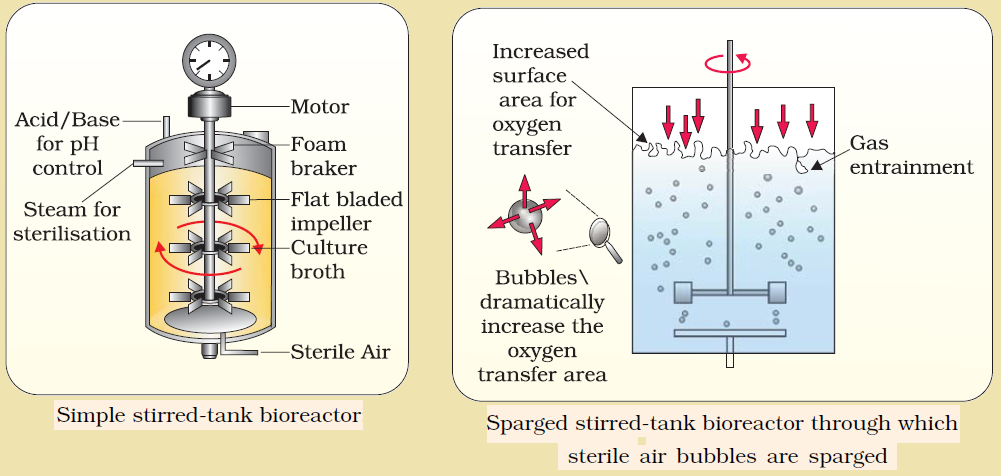
Illustrate the design of a bioreactor. Highlight the difference between a flask in your laboratory and a bioreactor which allows cells to grow in a continuous culture system.
Answer

Small volume cultures cannot yield appreciable quantities of products. To produce in large quantities, the development of bioreactors, where large volumes (100-1000 litres) of culture can be processed, was required. Thus, bioreactors can be thought of as vessels in which raw materials are biologically converted into specific products, individual enzymes, etc., using microbial plant, animal or human cells. A bioreactor provides the optimal conditions for achieving the desired product by providing optimum growth conditions (temperature, pH, substrate, salts, vitamins, oxygen).
Structure of Bioreactor:
  • It is a cylindrical structure with a curved base.
  • A stirrer is present for even mixing and oxygen availability throughout the reactor.
  • There is an agitator system, an oxygen delivery system, a foam control system, a temperature control system, etc.
  • There is a sampling port through which small volumes of culture can be taken out periodically.
A flask in a laboratory cannot be used for producing recombinant DNA on large scale. Unlike a bioreactor; a flask cannot be used to grow culture continuously.
Difference:
 
Flask
 
Bioreactor
i.
Flask is used to small laboratory scale testing of a culture.
i.
Bioreactor is used for commercial scale production.
ii.
The cells harbouring cloned genes of interest may be grown on a small scale in the laboratory.
ii.
The cells can also be multiplied in a continuous culture system wherein the used medium is drained out from one side while fresh medium is added from the other to maintain the cells in their physiologically most active log/ exponential phase. This type of culturing method produces a larger biomass leading to higher yields of desired protein.
iii.
Small volume cultures cannot yield appreciable quantities of products.
iii.
To produce in large quantities, the development of bioreactors, where large volumes (100–1000 litres) of culture can be processed, was required.

Need a full question paper?

Generate a complete, print-ready paper with questions like this in minutes — across 16+ boards, with answer keys.

Start Generating Free

Similar questions

In your view, what motivates the youngsters to take to alcohol or drugs and how can this be avoided?
Distinguish between: Food chain and Food web.
There is only one possible sequence of amino acids when deduced from a given nucleotide. But multiple nucleotide sequences can be deduced from a single amino acid sequence. Explain this phenomenon.
What are the various constituents of domestic sewage? Discuss the effects of sewage discharge on a river.
Cerebrum and cerebellum
For question 1-4, use this key:Key-
  1. Ecology.
  2. Population.
  3. Community.
  4. Ecosystem.
  1. A community plus its physical environment.
  2. Study of the interactions of organisms with each other and with the physical environment.
  3. All populations that are found in a particular area.
  4. All members of the same species that inhabit a particular area.
What are the objectives of biofortification ?
Observe the representation of genes involved in the lac operon given below:
  1. Identify the region where the repressor protein will attach normally.
  2. Under certain conditions repressor is unable to attach at this site. Explain.
  3. If repressor fails to attach to the said site what products will be formed by z, y and a?
  4. Analyse why this kind of regulation is called negative regulation.
A village health worker was taking a session with women. She tells the women that one has to be very careful while using oral pills as method of birth control. Wrong usage can actually promote conception.
Analyse the statement and compare the merits and demerits of using oral pills and surgical methods of birth control.
What are the main features of respiratory surface?