MCQ
In  $[0, 1]$ Lagrange's mean value theorem is $ NOT$  applicable to
  • $f(x) = \left\{ {\begin{array}{*{20}{c}}
      {\frac{1}{2} - x,\,\,\,\,\,\,\,\,\,x < \frac{1}{2}} \\ 
      {{{\left( {\frac{1}{2} - x} \right)}^2},\,x \geqslant \frac{1}{2}} 
    \end{array}} \right.$
  • B
    $f(x) = \left\{ {\begin{array}{*{20}{c}}
      {\frac{{\sin x}}{x}\,\,x \ne 0} \\ 
      {1,\,\,\,\,\,\,\,\,x = \frac{1}{2}} 
    \end{array}} \right.$
  • C
    $f(x) = x|x|$
  • D
    $f(x) = |x|$

Answer

Correct option: A.
$f(x) = \left\{ {\begin{array}{*{20}{c}}
  {\frac{1}{2} - x,\,\,\,\,\,\,\,\,\,x < \frac{1}{2}} \\ 
  {{{\left( {\frac{1}{2} - x} \right)}^2},\,x \geqslant \frac{1}{2}} 
\end{array}} \right.$
a
(a) The function defined in option $ (a) $ is not differentiable at $x = \frac{1}{2}$.

Need a full question paper?

Generate a complete, print-ready paper with questions like this in minutes — across 16+ boards, with answer keys.

Start Generating Free

Similar questions

Statement $1$ : The degrees of the differential equations $\frac{{dy}}{{dx}} + {y^2} = x$ and $\frac{{{d^2}y}}{{d{x^2}}} + y = \sin \,x$ are equal

Statement $2$ : The degree of a differential equation, when it is a polynomial equation in derivatives, is the highest positive integral power of the highest order derivative involved in the differential equation, otherwise degree is not defined

If ${\left\{ {\left( \begin{gathered}
  3\,\,1\,\,2 \hfill \\
  8\,\,9\,\,5 \hfill \\
  1\,\,\,1\,\,3 \hfill \\ 
\end{gathered}  \right)\,\left( \begin{gathered}
  1\,\,3\,\,3 \hfill \\
  3\,\,2\,\,7 \hfill \\
  3\,\,7\,\,9 \hfill \\ 
\end{gathered}  \right)\left( \begin{gathered}
  3\,\,8\,\,1 \hfill \\
  1\,\,\,9\,\,1 \hfill \\
  2\,\,5\,\,3 \hfill \\ 
\end{gathered}  \right)} \right\}^2}\, = \,\left( \begin{gathered}
  a_1\,\,a_2\,\,a_3 \hfill \\
  b_1\,\,b_2\,\,b_3 \hfill \\
  c_1\,\,c_2\,\,c_3 \hfill \\ 
\end{gathered}  \right)$ 

then the value of $|a_2 - b_1| + |a_3 - c_1| + |b_3 - c_2|$ is

If $A = \left\{ {1,2,3,......m} \right\},$ then total number of reflexive relations that can be defined from $A \to A$ is 
Let the functions $f: R \rightarrow R$ and $g : R \rightarrow R$ be defined by

$f(x)=e^{x-1}-e^{-|x-1|} \text { and } g(x)=\frac{1}{2}\left(e^{x-1}+e^{1-x}\right) \text {. }$ Then the area of the region in the first quadrant bounded by the curves $y=f(x), y=g(x)$ and $x=0$ is

If the curves $y = x^3 + ax$ and $y = bx^2 + c $pass through the point $(-1, 0)$ and have common tangent line at this point, then the value of $a+b$ is?
The area of the region bounded by the curve $x = 2y + 3$ and lines $y = 1$ and $y = –1$ is:
Choose the correct answer from the given four options.
The angle between two vectors $\vec{\text{a}}$ and $\vec{\text{b}}$ with magnitudes $\sqrt{3}$ and 4, respectively, and $\vec{\text{a}}\cdot\vec{\text{b}}=2\sqrt{3}$ is:
Let $f : R \to R$ , where $f(x) = \frac{{a{x^2} + ax + b}}{{ax + b}}$ , then
The normal at the point $(1, 1)$ on the curve $2y + x^2 = 3$ is :
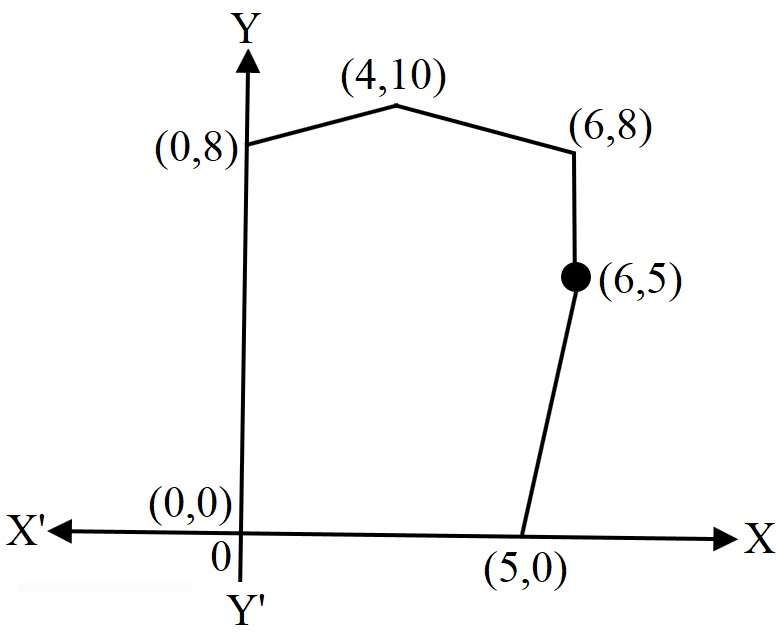
The feasible solution for a LPP is shown in the following figure. Let Z = 3x - 4y be the objective function.

Minimum of Z occurs at: