MCQ
In a buffer solution containing equal concentration of $B^-$ and $HB,$ the $K_b$ for $B^-$ is $10^{-10}.$ The $pH$ of buffer solution is
- A$10$
- B$7$
- C$6$
- ✓$4$
$p O H=p K_{b}+\log \frac{[\text { salt }]}{\text { loase }}$
$p H+p O H=14$
$K_{b}=1 \times 10^{-10},[\text { salt }]=[b a s e]$
$p O H=-\log K_{b}+\log \frac{[\text {salt}]}{[b a s e]}$
$\therefore \quad p O H=-\log \left(1 \times 10^{-10}\right)+\log 1=10$
$p H+p O H=14$$\left[\because \text { concentration of }\left[B^{-}\right]=[H B]\right.$
$p H=14-10=4$
Generate a complete, print-ready paper with questions like this in minutes — across 16+ boards, with answer keys.
$A$. $T _4 > T _3 > T _2 > T _1$
$B.$ The black body consists of particles performing simple harmonic motion.
$C.$ The peak of the spectrum shifts to shorter wavelength as temperature increases.
$D.$ $\frac{ T _1}{ v _1}=\frac{ T _2}{ v _2}=\frac{ T _3}{ v _3} \neq$ constant
$E.$ The given spectrum could be explained using quantisation of energy.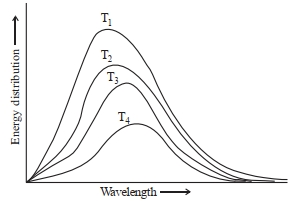
$F{e^{ + 3}}\left( {aq} \right) + {e^ - } \to F{e^{2 + }}\left( {aq} \right);{E^o} = + 0.77\,V$
$A{l^{ + 3}}\left( {aq} \right) + 3{e^ - } \to Al\left( s \right);{E^o} = - 1.66\,V$
$B{r_2}\left( {aq} \right) + 2{e^ - } \to 2B{r^ - };{E^o} = + 1.09\,V$
Considering the electrode potentials, which of the following represents the correct order of reducing power?
Reason $R:$ The increasing nuclear charge outweighs the shielding across the period.
In the light of the above statements, choose the most appropriate from the options given below: