Question
In a certain charge distribution, all points having zero potential can be joined by a circle S. Points inside S have positive potential and points outside S have negative potential. A positive charge, which is free to move, is placed inside S(a) It will remain in equilibrium(b) It can move inside S, but it cannot cross S(c) It must cross S at some time(d) It may move, but will ultimately return to its starting point


Answer

(c) It must cross S at some time

Need a full question paper?

Generate a complete, print-ready paper with questions like this in minutes — across 16+ boards, with answer keys.

Start Generating Free

Similar questions

The energy of a photon of light with wavelength $5000 \mathring A$ is approximately $2.5 \ eV .$ This way the energy of an $X-$ray photon with wavelength $1 \mathring A$ should be
Assertion :   Through the same current flows through the line wires and the filament of the bulb but heat produced in the filament is much higher then that in line wires.
Reason     : The filament of bulbs is made of a material of high resistance and high melting point.(a) If both assertion and reason are true and the reason is the correct explanation of the assertion.(b) If both assertion and reason are true but reason is not the correct explanation of the assertion.(c) If assertion is true but reason is false.(d) If the assertion and reason both are false.


Two charged spheres of radii R, and R2 are connected by a wire. The ratio of the electric fields of the spheres is:
In a RLC circuit capacitance is changed from C to 2C. For the resonant frequency to remain unchanged, the inductance should be changed from L to.
The angular momentum of the α−particles which are scattered through large angles by the heavier nuclei, is conserved because:
Dipole moment depends on _______?
In an $NPN$ transistor circuit, the collector current is $10 mA$. If $90\%$ of the electrons emitted reach the collector, the emitter current $(i_E)$ and base current $(i_B)$ are given by
A circular disc $A$ of radius $r$ is made from an iron plate of thickness $(t)$ and another circular disc $B$ of radius $4r$ is made from an iron plate of thickness $\frac{\text{t}}{4}.$ The relation between the moments of inertia $I_A$ and $I_B$ is:
The resistance of an ideal voltmeter is(a) Zero  (b) Very low(c) Very large(d) Infinite
       
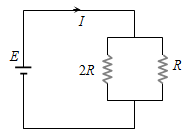
What is the ratio of heat generated in $R$ and $2R$