Question
In a charged capacitor, the energy resides

Answer

(c) As the electric field outside the capacitor plates is zero and field only exists in the between the plates, the energy will reside in field between the plates.

Need a full question paper?

Generate a complete, print-ready paper with questions like this in minutes — across 16+ boards, with answer keys.
Start Generating Free

Similar questions

Two waves have their amplitudes in the ratio $1 : 9$. The maximum and minimum intensities when they interfere are in the ratio
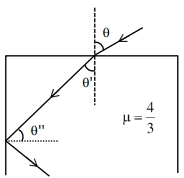
A ray of light entering from air into a denser medium of refractive index $\frac{4}{3}$, as shown in figure. The light ray suffers total internal reflection at the adjacent surface as shown. The maximum, value of angle $\theta$ should be equal to -
Assertion : Standard optical diffraction gratings can not be used for discriminating between $X-$ ray wavelengths.

Reason : The grating spacing is not of the order of $X-$ ray wavelengths.

A round body is given translational velocity and released on a surface that has friction. Then
Select the incorrect relation. (Where symbols have their usual meanings)
A carbon dioxide laser emits sinusoidal electro-magnetic wave that travels in vacuum in the negative $x-$ direction. The wavelength is $10.6\,\mu $ and $\vec E$ fields is parallel to $z-$ axis, with $E_{max} = 1.5 \times 10^6\, M\, v/m$. Then vector equations for $\vec E$  and $\vec B$ as a function of time and position are
The ratio of the refractive index of red light to blue light in air is
A car of mass $ ‘m’ $ is driven with acceleration $ ‘a’ $ along a straight level road against a constant external resistive force $ ‘R’.$  When the velocity of the car is $‘V’, $ the rate at which the engine of the car is doing work will be
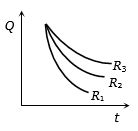
Three identical capacitors are given a charge $Q$ each and they are then allowed to discharge through resistance $R_1, R_2\,$ and $\,R_3$. Their charges, as a function of time shown in the graph below. The smallest of the three resistance is
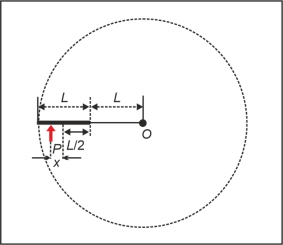
A thin uniform rod of length $L$ and certain mass is kept on a frictionless horizontal table with a massless string of length $L$ fixed to one end (top view is shown in the figure). The other end of the string is pivoted to a point $O$. If a horizontal impulse $P$ is imparted to the rod at a distance $x=L / n$ from the mid-point of the rod (see figure), then the rod and string revolve together around the point $O$, with the rod remaining aligned with the string. In such a case, the value of $n$ is. . . . . .