Question
In a class, the teacher was explaining a concept from weather and climate chapter. Anand got confused and slowly asked his teacher to repeat again. She smiled and started again. In equatorial belt the climate is hot and wet. It has evergreen rainforest and variety of plants. Similarly the vegetation of tropical region also has variations. The forest located between two tropics is called tropical forest. Desert shows arid region and only xerophytes are observed. These plants show specific modification for their survival in this arid region.
  1. Which type of forest is formed in equatorial region?
  2. What are the variation in vegetation seen in tropical forest?
  3. Give some adaptations of plants that are formed in desert.
  4. Some places conifers are seen. What are these places?
  5. What values do we observe in the teacher and Ar\and?
Answer

  1. Evergreen rainforest with the greatest variety of plants are seen in equational region.
  2. In tropical regions, vegetation varies from broad leaves evergreen trees to tropical deciduous trees to grassland.
  3. The plants in the arid of desert regions have modified leaves covered with hair or waxy coating and an extensive root system.
  4. Conifers are maintained and adapted to withstand snow fall and shortage of water in colder belt.
  5. Anand is observant and sincere boy. He is not afraid to ask Question in the class.

Need a full question paper?

Generate a complete, print-ready paper with questions like this in minutes — across 16+ boards, with answer keys.

Start Generating Free

Similar questions

Describe the function of the heart.
Explain different modes of unisexual reproduction?
What are permanent tissues? Describe the different types of simple permanent tissues.
Why is it important to use SI units while recording measurements?
In the figure, label the arrows and indicate the direction of
  1. Movement of air.
  2. Movement of diaphragm.
  3. Movement of ribs.
Fill in the blanks of the following paragraph using just two words – arteries and veins.
___$(a)$___ carry oxygen-rich blood from the heart to all parts of the body and ___ $(b)$___ carry carbon dioxide-rich blood from all parts of the body back to the heart. ___ $(c)$___ have thin walls and __ $(d)$___ have thick elastic walls. Blood flows at high pressure in ___ $(e)$____. Valves are present in __ $(f)$ ___ which allow blood to flow only towards the heart. __ $(g)$___ divide into smaller vessels. These vessels further divide into extremely thin tubes called capillaries. The capillaries join up to form ____ $(h)$_____.
Explain the concept of chemical reactions with two examples.


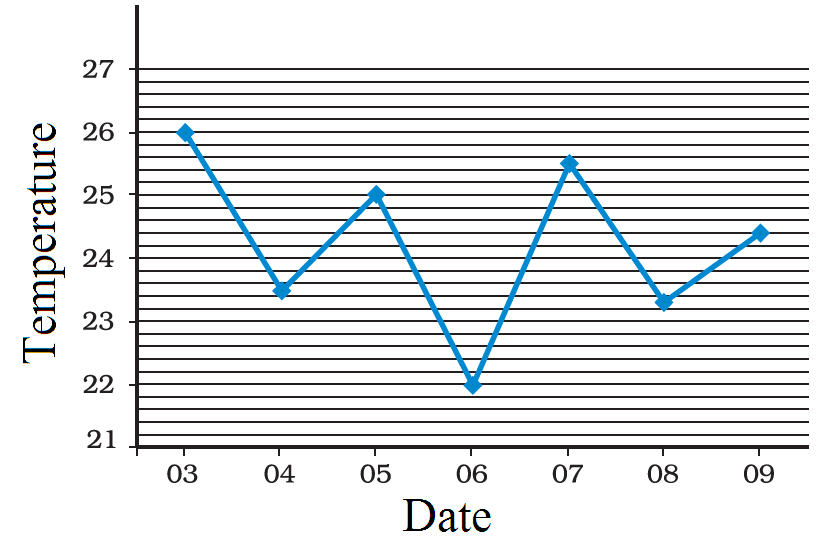
The following graph shows the change in temperature. Answer according to the reading of graph.
  1. Draw a table and fill the temperature change of each day.
  2. Which day show the highest temperature?
  3. Which day shows the minimum temperature?
Describe how day and night occur using a globe and a torch model.
Write the scientific terms for the following.
  1. The level of water under the ground.
  2. The process of seeping of water into the ground.
  3. The circulation of water on the earth.
  4. The wise and judicious use of water.
  5. Seeped water that collects between the layers of hard rocks.