MCQ
In a complex, the highest possible coordination number is
- A$6$
- B$12$
- C$4$
- ✓$8$
Generate a complete, print-ready paper with questions like this in minutes — across 16+ boards, with answer keys.
$1.$ The structure of compound ${P}$ is
mcq $Image$
$2.$ The structure of the compound ${Q}$ is
mcq $Image$
Give the answer question $1,2$ and $3.$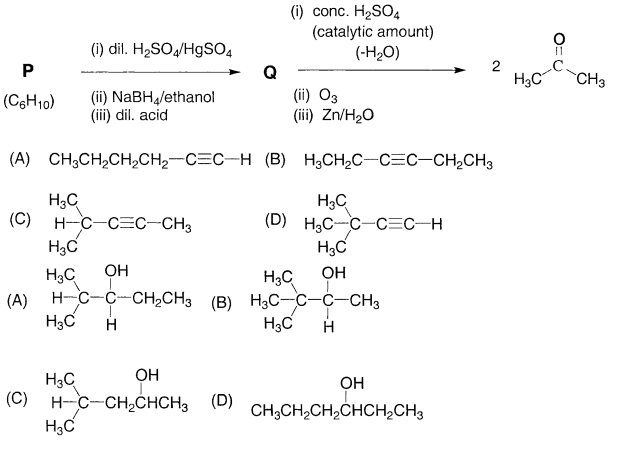
$(I)$ they exhibit high enthalpies of atomisation as the $d-$ subshell is full
$(II)$ $zn$ and $Cd$ do not show variable oxidation states while $Hg$ shows $+ I$ and $+ II$
$(III)$ Compound of $Zn,\,Cd$ and $Hg$, are paramagnetic in nature
$(IV)$ $Zn,\,Cd$ and $Hg$ are called soft metals
$6 \mathrm{OH}^{-}+\mathrm{Cl}^{-} \rightarrow \mathrm{ClO}_{3}^{-}+3 \mathrm{H}_{2} \mathrm{O}+6 \mathrm{e}^{-}$
A current of $x A$ has to be passed for $10 h$ to produce $10.0 \mathrm{~g}$ of potassium chlorate. The value of $\mathrm{x}$ is $.......$ (Nearest integer)
(Molar mass of $\left.\mathrm{KClO}_{3}=122.6 \mathrm{~g} \mathrm{~mol}^{-1}, \mathrm{~F}=96500 \mathrm{C}\right)$