Question
In a Coolidge tube, electrons strike the target and stop inside it. Does the target get more and more negatively charged as time passes?

Answer

An electron emitted from the filament undergoes a number of collisions inside the material and loses its kinetic energy before coming to rest. This energy is utilised to give out photons or reject electrons from the atoms of the target. These electrons move to the battery connected to the circuit. Thus, the target does not get more and more negatively charged as time passes.

Need a full question paper?

Generate a complete, print-ready paper with questions like this in minutes — across 16+ boards, with answer keys.
Start Generating Free

Similar questions

Calculate the magnetic dipole moment corresponding to the motion of the electron in the ground state of a hydrogen atom.
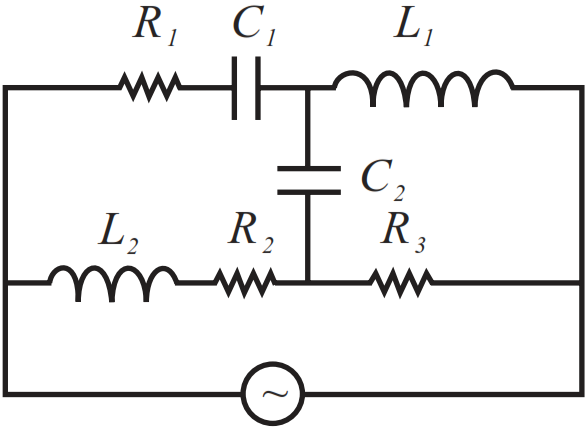
Draw the effective equivalent circuit of the circuit shown in Fig, at very high frequencies and find the effective impedance.
An electromagnetic wave of wavelength $\lambda$ is incident on a photosensitive surface of negligible work function. If the photoelectrons emitted from the surface have the same de Broglie wavelength $\lambda\text{B,}$ prove that $\lambda=\Big(\frac{2\text{mc}}{\text{h}}\Big)\lambda^2_\text{B}.$
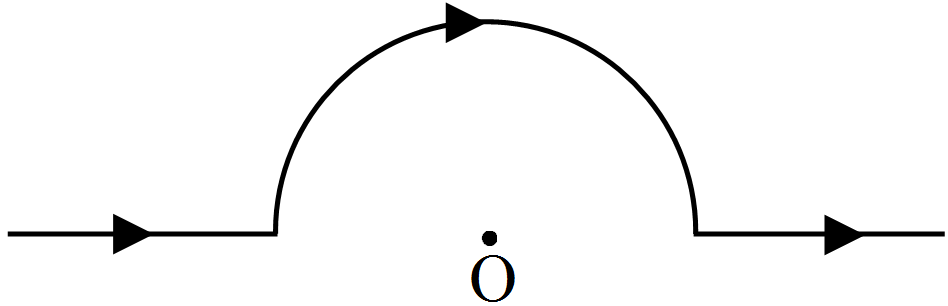
A straight wire carrying a current of 12A is bent into a semi-circular arc of radius 2.0cm as shown. What is the magnetic field at O due to:
  1. Straight segments.
  2. The semi-circular arc?
Two capacitors of capacitances $4.0\mu\text{F}$ and $6.0\mu\text{F}$ are connected in series with a battery of 20V. Find the energy supplied by the battery.
State the Lenz's law regarding electromagnetic induction. This law is based on the conservation law of which quantity?
A horizontal conducting wire of length 2 m oriented in east-west direction is falling down with a speed of 5 m/s perpendicular to the horizontal component of earth's magnetic field of $0.3 \times 10^{-4} T.$ Calculate the instantaneous value of induced emf across the ends of the wire.
Which constituent radiation of the electromagnetic spectrum is used:
  1. In RADAR,
  2. To photograph internal parts of a human body,
  3. For taking photographs of the sky during night and foggy conditions?
Give one reason for your answer in each case.
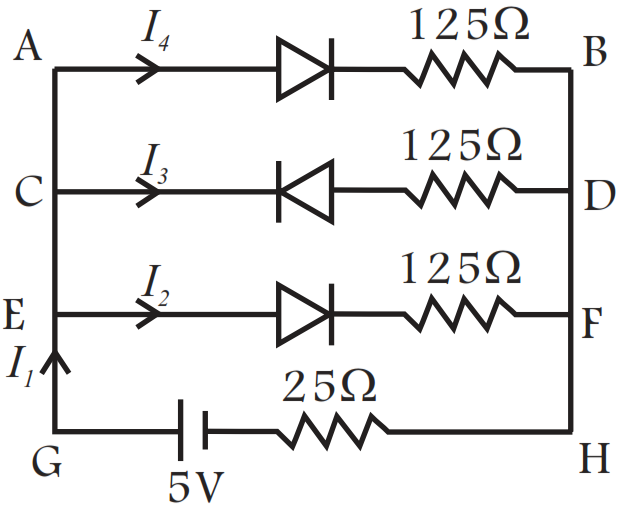
If each diode in Fig. has a forward bias resistance of $25\Omega$ and infinite resistance in reverse bias, what will be the values of the current $I_1, I_2, I_3$ and $I_4$?
A disc of radius 10cm is rotating about its axis at an angular speed of 20rad/s. Find the linear speed of:
  1. A point on the rim.
  2. The middle point of a radius.
Draw the graphs for variation of potential energy and nuclear force between two nucleons as a function of distance between them.