Question
In a Coolidge tube, electrons strike the target and stop inside it. Does the target get more and more negatively charged as time passes?

Answer

An electron emitted from the filament undergoes a number of collisions inside the material and loses its kinetic energy before coming to rest. This energy is utilised to give out photons or reject electrons from the atoms of the target. These electrons move to the battery connected to the circuit. Thus, the target does not get more and more negatively charged as time passes.

Need a full question paper?

Generate a complete, print-ready paper with questions like this in minutes — across 16+ boards, with answer keys.
Start Generating Free

Similar questions

What is the nature of sound waves in air? How is the speed of sound waves in atmosphere affected by the (i) humidity (ii) temperature?
A train standing at the outer signal of a railway station blows a whistle of frequency 400Hz still air. The train begins to move with a speed of 10m s-1 towards the platform. What is the frequency of the sound for an observer standing on the platform? (sound velocity in air = 330m s–1)
The radius of gyration of a uniform disc about a line perpendicular to the disc equals its radius. Find the distance of the line from the centre.
The thickness of a glass plate is measured to be 2.17mm, 2.17mm and 2.18mm at three different places. Find the average thickness of the plate from this data.
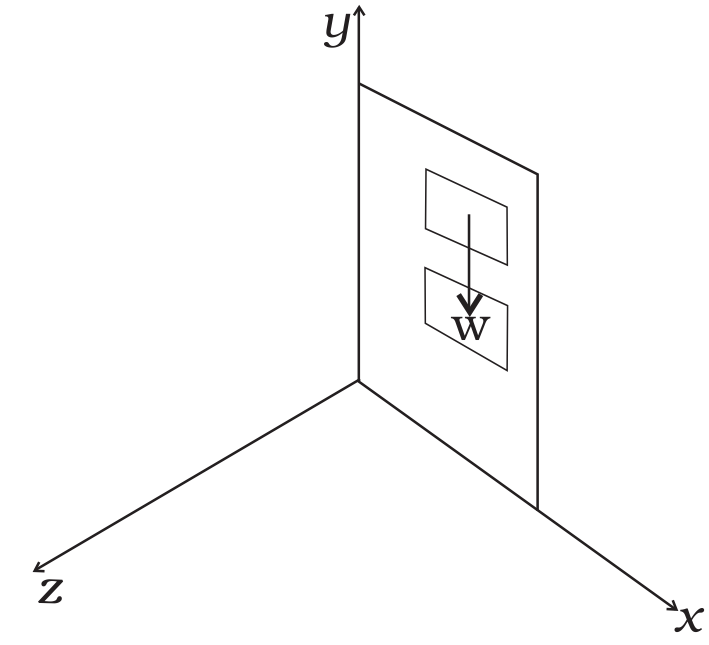
A door is hinged at one end and is free to rotate about a vertical axis. Does its weight cause any torque about this axis? Give reason for your answer.

A 10cm long rod carries a charge of $+50\mu\text{C}$ distributed uniformly along its length. Find the magnitude of the electric field at a point 10cm from both the ends of the rod.
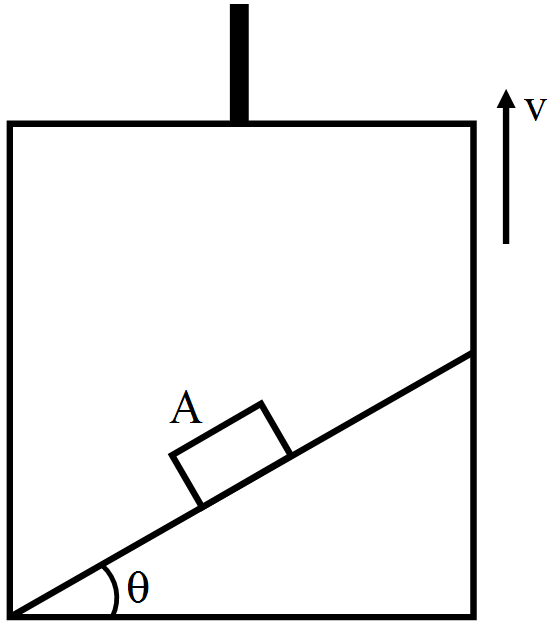
A block A can slide on a frictionless incline of angle $\theta$ and length l, kept inside an elevator going up with uniform velocity v. Find the time taken by the block to slide down the length of the incline if it is released from the top of the incline.

A constant force of 2.50N accelerates a stationary particle of mass 15g through a displacement of 2.50m. Find the work done and the average power delivered.
A body is suspended by a string of length 1m and is projected horizontally with velocity 4m/ s. Calculate the tangential and radial accelerations when the string rises by 60° from its initial position. Also find the difference in velocity.
A convex lens produces a double size real image when an object is placed at a distance of 18cm from it. Where should the object be placed to produce a triple size real image?