MCQ
In a current carrying conductor the net charge is:
- A1.6 × 10–19 coulomb.
- B6.25 × 10–18 coulomb.
- CZero.
- DInfinite.
Generate a complete, print-ready paper with questions like this in minutes — across 16+ boards, with answer keys.
A charge of 40 μC is given to a capacitor having capacitance C = 10 μF. The stored energy in ergs is
|
(a) 80 |
(b) 800 |
(c) 80 |
(d) 8000 |
Which of the following would you prefer to use while reading small letters found in a dictionary?
A convex lens of power + 6D is placed in contact with a concave lens of power – 4D. What is the nature and focal length of the combination
|
(a) Concave, 25 cm |
(b) Convex, 50 cm |
(c) Concave, 20 cm |
(d) Convex, 100 cm |
The figure illustrate how B, the flux density inside a sample of unmagnetised ferromagnetic material varies with B0, the magnetic flux density in which the sample is kept. For the sample to be suitable for making a permanent magnet

|
(a) OQ should be large, OR should be small |
|
(b) OQ and OR should both be large |
|
(c) OQ should be small and OR should be large |
|
(d) OQ and OR should both be small |
In the given circuit, the voltmeter records 5 volts. The resistance of the voltmeter in ohms is
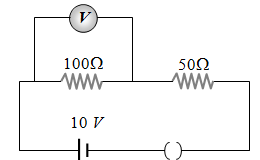
|
(a) 200 |
(b) 100 |
(c) 10 |
(d) 50 |
A current carrying solenoid is approaching a conducting loop as shown in the figure. The direction of induced current as observed by an observer on the other side of the loop will be
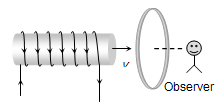
|
(a) Anticlockwise |
(b) Clockwise |
(c) East |
(d) West |
A ball of mass 1 g and charge  moves from a point A. where potential is 600 volt to the point B where potential is zero. Velocity of the ball at the point B is 20 cm/s. The velocity of the ball at the point A will be
|
(a) 22.8 cm/s |
(b) 228 cm/s |
(c) 16.8 m/s |
(d) 168 m/s |
