MCQ
In a cyclic process, work done by the system is
  • A
    Zero
  • Equal to heat given to the system
  • C
    More than the heat given to system
  • D
    Independent of heat given to the system

Answer

Correct option: B.
Equal to heat given to the system
(b) For cyclic forces $\Delta U=0$So, $\Delta Q=\Delta W$

Need a full question paper?

Generate a complete, print-ready paper with questions like this in minutes — across 16+ boards, with answer keys.
Start Generating Free

Similar questions

A cyclist taking turn bends inwards while a car passenger taking same turn is thrown outwards. The reason is
Acceleration due to gravity on moon is $1 / 6$ of the acceleration due to gravity on earth. If the ratio of densities of earth $\left(\rho_e\right)$ and moon $\left(\rho_m\right)$ is $\left(\frac{\rho_e}{\rho_m}\right)=\frac{5}{3}$ then radius of moon $R$ in terms of $R$ will be
Oersted is a unit of
A spherical body of mass $m$ and radius $r$ is allowed to fall in a medium of viscosity $\eta$. The time in which the velocity of the body increases from zero to 0.63 times the terminal velocity $(v)$ is called time constant $(\tau)$. Dimensionally $\tau$ can be represented by
If $P$ represents radiation pressure, $c$ represents speed of light and $Q$ represents radiation energy striking a unit area per second, then non-zero integers $x, y$ and $z$ such that $P^x Q^y c^z$ is dimensionless, are
Consider an electron in the $\pi$ orbit of a hydrogen atom in the Bohr model. The circumference of the orbit can be expressed in terms of the de Broglie wavelength $\lambda$ of that electron as
A gas $(\gamma=1.3)$ is enclosed in an insulated vessel fitted with insulating piston at a pressure of $10^5 \mathrm{~N} / \mathrm{m}^2$. On suddenly pressing the piston the volume is reduced to half the initial volume. The final pressure of the gas is
In an adiabatic expansion of a gas initial and final temperatures are $T_1$ and $T_2$ respectively, then the change in internal energy of the gas is
A cycle tyre bursts suddenly. This represents an
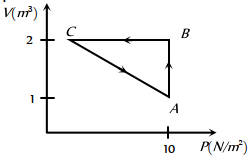
An ideal gas is taken through the cycle $A \rightarrow B \rightarrow C \rightarrow A$, as shown in the figure. If the net heat supplied to the gas in the cycle is $5 \mathrm{~J}$, the work done by the gas in the process $C \rightarrow A$ is