MCQ
In a cyclic process, work done by the system is
  • A
    Zero
  • Equal to heat given to the system
  • C
    More than the heat given to system
  • D
    Independent of heat given to the system

Answer

Correct option: B.
Equal to heat given to the system
(b) For cyclic forces $\Delta U=0$So, $\Delta Q=\Delta W$

Need a full question paper?

Generate a complete, print-ready paper with questions like this in minutes — across 16+ boards, with answer keys.

Start Generating Free

Similar questions

X-rays were discovered by
A force of $5 \mathrm{~N}$ acts on a $15 \mathrm{~kg}$ body initially at rest. The work done by the force during the first second of motion of the body is
Two adjacent piano keys are struck simultaneously. The notes emitted by them have frequencies $n_1$ and $n_2$. The number of beats heard per second is
Nature of meniscus for liquid of $0^{\circ}$ angle of contact
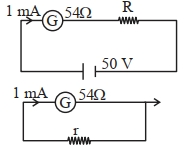
For designing a voltmeter of range $50\,V$ and an ammeter of range $10\,mA$ using a galvanometer which has a coil of resistance $54\,\Omega$ showing a full scale deflection for $1\,mA$ as in figure.

$(A)$ for voltmeter $R \approx 50\,k\Omega$

$(B)$ for ammeter $r \approx 0.2\,\Omega$

$(C)$ for ammeter $r \approx 6\,\Omega$

$(D)$ for voltmeter $R \approx 5\,k \Omega$

$(E)$ for voltmeter $R \approx 500 \Omega$

Choose the correct answer from the options given below
In an ac circuit, the current is given by $i=5 \sin \left(100 t-\frac{\pi}{2}\right)$ and the ac potential is $V=200 \sin (100)$ volt. Then the power consumption is
The phase difference between two waves represented by
$y_1=10^{-6} \sin [100 t+(x / 50)+0.5] m $
$y_2=10^{-6} \cos [100 t+(x / 50)] m $
where $x$ is expressed in metres and $t$ is expressed in seconds, is approximately
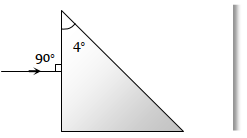
A prism having an apex angle 4 and refraction index $1.5$ is located in front of a vertical plane mirror as shown in figure. Through what total angle is the ray deviated after reflection from the mirror
Image
If work function of metal is $3\ \mathrm{eV}$ then threshold wavelength will be
In the Bohr model of a hydrogen atom, the centripetal force is furnished by the coulomb attraction between the proton and the electron. If $a_0$ is the radius of the ground state orbit, $m$ is the mass, $e$ is the charge on the electron and $\varepsilon_0$ is the vacuum permittivity, the speed of the electron is