Question
In a cyclic quadrilateral $ABCD$, it is given that $\angle\text{A}=(\text{2x}+4)^\circ,\ \angle\text{B}=(\text{y}+3)^\circ,$ $\angle\text{C}=(\text{2y}+10)^\circ$ and $\angle\text{D}=(\text{4x}-5)^\circ$ Find the four angles.

Answer

Given that in a cyclic quadrilateral $ABCD$,
$\angle\text{A}=(\text{2x}+4)^\circ,\ \angle\text{B}=(\text{y}+3)^\circ,$
$\angle\text{C}=(\text{2y}+10)^\circ$ and $\angle\text{D}=(\text{4x}-5)^\circ$
We know that,
Opposite angles of a quadrilateral sum upto $180^\circ $
$\Rightarrow\angle\text{B}+\angle\text{D}=180^\circ$
$\Rightarrow (y + 3)^\circ + (4x - 5)^\circ = 180^\circ $
$\Rightarrow 4x + y = 182 ...(i)$
Similarly, $\angle\text{A}+\angle\text{C}=180^\circ$
$\Rightarrow (2x + 4)^\circ + (2y + 10)^\circ = 180^\circ $
$\Rightarrow 2x + 2y = 166$
$\Rightarrow x + y = 83 ...(i)$
Subtracting $(ii)$ from $(i)$, we get
$\Rightarrow 3x = 99$
$\Rightarrow x = 33$
Substituting $x = 33$ in $(ii)$, we get
$\Rightarrow y = 50$
Hence, the angles of $ABCD$ are
So, $\angle\text{A}=70^\circ,\ \angle\text{B}=53^\circ,$
$\angle\text{C}=110^\circ$ and $\angle\text{D}=127^\circ$

Need a full question paper?

Generate a complete, print-ready paper with questions like this in minutes — across 16+ boards, with answer keys.
Start Generating Free

Similar questions

Find the coordinates of the points of trisection of the line segment joining $(4, –1)$ and $(–2, –3)$.
Find the distance between of the following points from the origin:
$B(-5, 5)$
A two-digit number is $3$ more than $4$ times the sum of its digits. If $8$ is added to the number, the digits are reversed. Find the number.
A kite is flying at a height of $75 \ m$ from the level ~round, a ched to a string inclined at $60^{\circ}$ to the hori ontal. Find th length of the string, assuming that there is no slack in it. [Take $\sqrt{3}=1.732]$
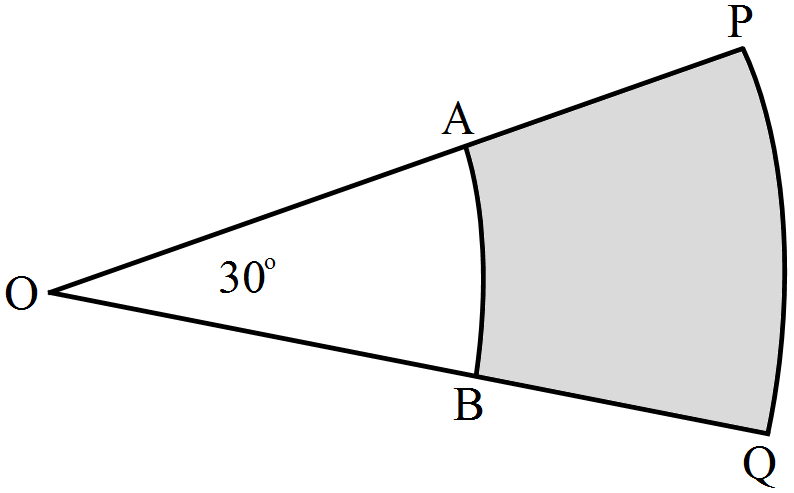
In the given figure, $PQ$ and $AB$ are respectively the arcs of two concentric circles of radii $7\ cm$ and $3.5\ cm$ with centre $0$. If $\angle\text{POQ}=30^\circ,$ find the area of the shaded region.
Each of the equal sides of an isosceles triangle measures $2\ cm$ more than its height, and the base of the triangle measures $12\ cm$. Find the area of the triangle.
Use Euclid's algorithm to find $HCF$ of $1190$ and $1445$. express the $HCF$ in the form $1190m + 1445n.$
When $3$ is added to the denominator and $2$ is subtracted from the numerator a fraction becomes $\frac{1}{4}.$ And when $6$ is added to numerator and the denominator is multiplied by $3$, it becomes $\frac{2}{3}.$ Find the fraction.
Divide $27$ into two parts such that the sum of their reciprocals is $\frac{3}{20}.$
A tower subtends an angle $\alpha$ at a point A in the plane of its base and the angles of depression of the foot of the tower at a point b metres just above A is $\beta.$ Prove that the height of the tower is $\text{b}\tan\alpha\cot\beta.$