Question
In a cyclotron, a charged particle.

Answer

  1. Undergoes acceleration all the time.

Need a full question paper?

Generate a complete, print-ready paper with questions like this in minutes — across 16+ boards, with answer keys.
Start Generating Free

Similar questions

The potential gradient at which the dielectric of a condenser just gets punctured is called:
In Rutherford's $\alpha$-scattering experiment, if atomic number increases with thin metal foil then scattering angle is :
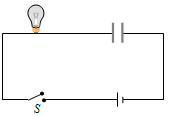
A light bulb, a capacitor and a battery are connected together as shown here, with switch $S$ initially open. When the switch $S$ is closed, which one of the following is true
Two bulbs each marked 100 W, 220 V are connected in series across 220 V supply. The power consumed by them, when lit, is
A charged particle moves in a gravity-free space without change in velocity. Which of the following is are possible:
  1. $\text{E}=0,\ \text{B}=0$
  2. $\text{E}=0,\ \text{B}\not=0$
  3. $\text{E}\not=0,\ \text{B}=0$
  4. $\text{E}\not=0,\ \text{B}\not=0$
By corpuscular theory of light, the phenomenon which can be explained is ____________.
A positive point charge Q is brought near an isolated metal cube.
  1. The cube becomes negatively charged.
  2. The cube becomes positively charged.
  3. The interior becomes positively charged and the surface becomes negatively charged.
  4. The interior remains charge free and the surface gets nonuniform charge distribution.
Two resistances are connected in two gaps of a metre bridge. The balance point is 20 cm from the zero end. A resistance of 15 ohms is connected in series with the smaller of the two. The null point shifts to 40 cm. The value of the smaller resistance in ohms is(a) 3 (b) 6(c) 9  (d) 12
       
In a simple harmonic motion:
  1. The potential energy is always equal to the kinetic energy.
  2. The potential energy is never equal to the kinetic energy.
  3. The average potential energy in any time interval is equal to the average kinetic energy in that time interval.
  4. The average potential energy in one time period is equal to the average kinetic energy in this period.
The main defect of Bohr's atom model is :